
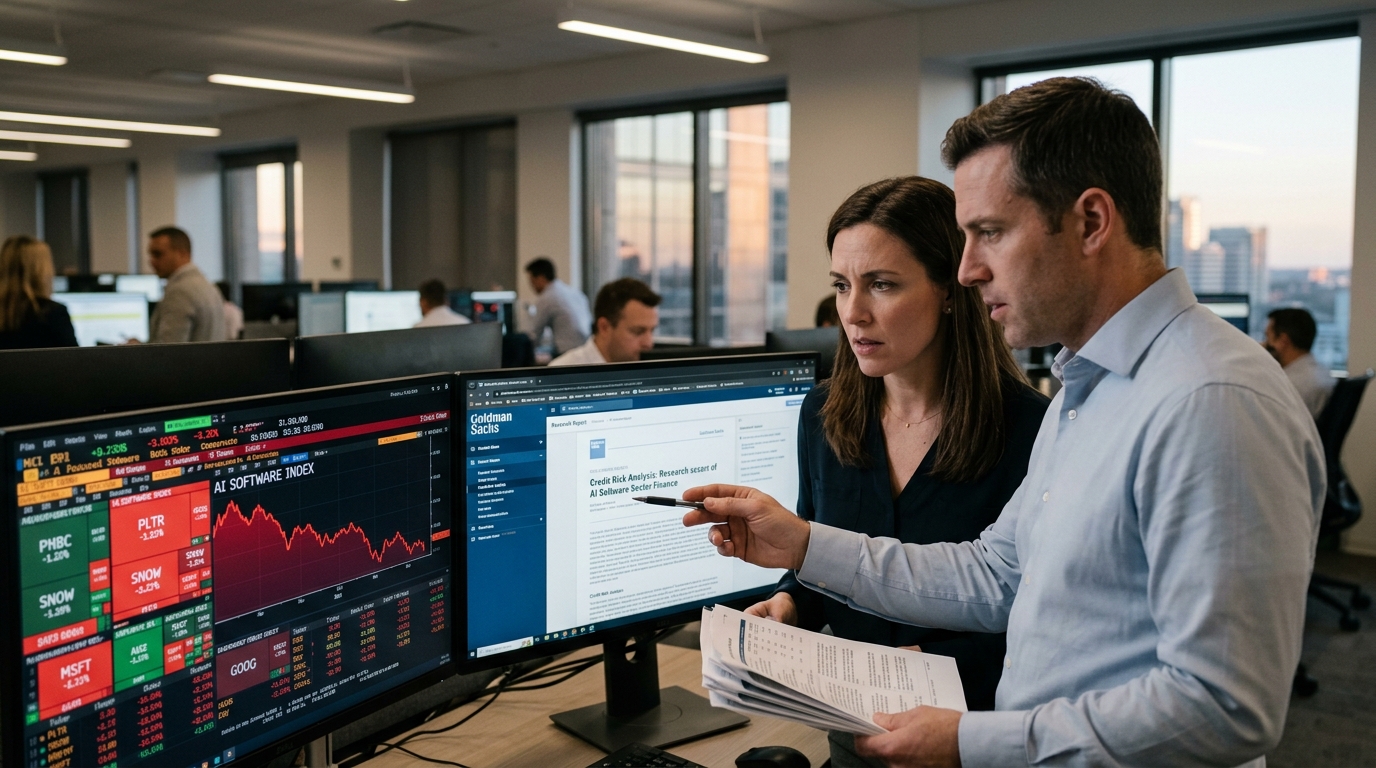
Until last week, traders tracking the AI unwind had a reasonably tidy story: semiconductors were getting hit, software was holding up. That distinction collapsed on Friday, October 16, 2026, and the speed of the collapse is the lesson worth studying.
AI-focused software names sold off hard as Wall Street fixated on the financing side of the AI buildout, after a note from Goldman Sachs helped put debt funding back at the center of the conversation. The Nasdaq did not just have a bad day. For the week, the Nasdaq fell 4.5%, ending a four-week winning streak with its worst week since June. That context matters: this was not a one-session wobble. It was five sessions of accumulated damage finally breaking the one pocket of the AI trade that bulls had treated as untouchable.
Palantir Technologies fell 7.22% on Friday, closing roughly 13% below its record from earlier in the week as technology stocks declined broadly. The victory lasted four trading sessions. That compression of euphoria into a handful of days, followed by an immediate correction, is a clean demonstration of what happens when a high-multiple stock runs ahead of the confirmation it needs.
The Goldman note did not announce a new fact. It quantified a risk the market had chosen to discount. By Goldman’s estimate, hyperscaler capex is expected to reach roughly $750 billion by year end 2026, and those companies are expected to fund a growing share of that spending in debt markets. That is a number investors had in their models. What changed Friday was the market’s willingness to keep assigning software multiples as though the credit question did not exist.
For the week, CoreWeave stock fell about 25% as investors grew increasingly concerned with the amount of debt that companies such as CoreWeave are taking on to fund the AI buildout. The cloud computing provider’s bonds saw their yield rise above 15% during the week, a level that shifts the conversation from equity risk to credit risk entirely. The selloff is a stark reminder that AI companies’ reliance on debt is becoming a risk for investors, puncturing the notion that companies at the heart of the AI boom are immune to macroeconomic headwinds.
Experienced traders recognize this pattern. A credit event prices equities faster than an earnings miss because it attacks the discount rate rather than just the numerator of a valuation model. Every future cash flow gets marked down simultaneously. Software stocks carrying 30-to-50-times revenue multiples are uniquely exposed to that math.
Goldman framed the move as a tactical rotation away from smaller AI names toward steadier large-cap AI exposure, or even non-AI stocks altogether. That rotation signal deserves attention. Some higher-quality software names were still holding up better than the most levered, momentum-heavy corners of the trade heading into Friday. Those are not accidents. They are the market sorting for cash flow visibility inside a sector that suddenly has to prove it can finance its own ambitions.
That sorting process has a precedent. Hyperscalers spending over $700 billion on capex in 2026 already forced investors to question whether AI returns justify the cost before depreciation charges arrive.
What comes next depends on whether this week’s damage is treated as a one-time reset in expectations or a catalyst for something larger. Investors are increasingly questioning whether massive AI spending can pay off anytime soon as elevated inflation keeps borrowing costs high. Wholesale inflation recorded its largest monthly gain since 2022 during the week, while consumer inflation remained above the Federal Reserve’s 2% target. That combination, tight money and debt-heavy expansion plans, is not a backdrop that forgives premium valuations easily.
The stress is visible beyond public equities. Major banks declined to underwrite the majority of a GPU-backed leveraged loan, leaving $3.7 billion to clear with investors on a best-efforts basis.
The trader’s lesson from Friday is not about Palantir specifically. It is about understanding where risk actually lives in any trade. When a position’s bull case depends on cheap capital remaining available indefinitely, a credit note is not a secondary risk. It is the primary one. Professionals who had sized AI software positions relative to their conviction in the demand story, rather than their conviction in the financing story, walked into Friday carrying more risk than they realized. That mismatch between where traders thought the risk was and where it actually sat is the most important thing the week produced.