
October 24, 2026
Bonus Content: Microsoft, Alphabet, Amazon, and Intel Report Together. Know Your Size Before Wednesday.
Blane Markham here,
I don’t know who needs to hear this, but…
Most traders spend far too much time staring at charts.
They monitor every tick.
Read every headline.
Watch every market commentator.
And somehow, after all that effort, they’re still struggling to produce consistent results.
That’s because more screen time doesn’t automatically create better trades.
In fact, one retired airline pilot discovered the opposite.
Instead of trying to predict every market move, he focused on a simple strategy built around a 5-day window.
❌ No all-day chart watching.
❌ No complicated indicators.
❌ No endless market analysis.
Just a straightforward process designed to identify high-potential opportunities and capture cash flow in a matter of days.
While there is always risk of loss in trading, the results were so impressive that he eventually replaced his income using this approach.
But today, we’re giving away a free report that explains exactly how this strategy works.
Inside you’ll discover:
- How a retired airline pilot used a simple 5-day trade strategy to create consistent income
- The #1 mistake most traders make (and how to avoid it)
- A repeatable process for finding double-digit opportunities
- Step-by-step trade blueprints you can begin studying immediately
Get your free copy here: Options Trading Made Easy.
If you’re tired of spending hours glued to the market, this may be exactly what you’ve been looking for.
In your corner,
Blane Markham on behalf of Hughes Optioneering
& TradeWins Publishing

2026 TradeWins.com. All Rights Reserved. Privacy Policy | Disclaimer | Terms and Conditions | Contact Us
Auto-trading, or any broker or advisor-directed type of trading, is not supported or endorsed by Markham Trading. The information provided by Markham Trading in its various materials, including trading recommendations, newsletters and educational publications is not customized or personalized for any particular person or risk profile. Past results are not necessarily indicative of future results. Results presented can vary and may not be typical for all subscribers. There are substantial risks involved with investing in the stock and options market, including the risk of total loss. You should only trade or invest “risk capital” – funds you can afford to lose.
Microsoft, Alphabet, Amazon, and Intel Report Together. Know Your Size Before Wednesday.
The market just absorbed Meta’s earnings. Now comes the harder part.
Meta reported revenue of $64.6 billion, up 26% year over year, and narrowed its 2026 capital-expenditure outlook to a range of $135 billion to $145 billion. The spending increase, not the revenue beat, is what the market remembered. U.S. stocks slid on the news, with the Nasdaq Composite down 2.6% in its largest decline since June 5, while Meta shares fell about 7%, erasing roughly $120 billion of market value. The message was blunt: investors are no longer ignoring what this AI arms race costs.
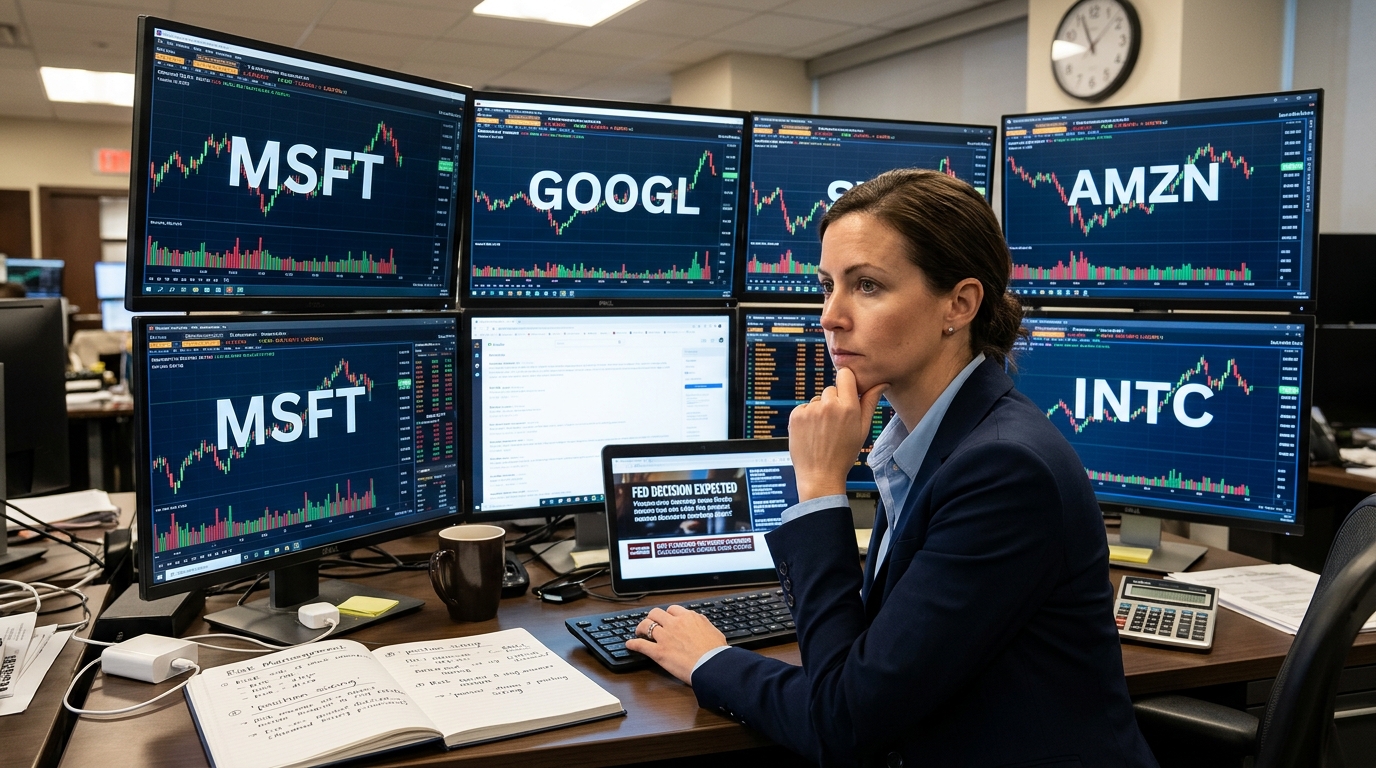
That question gets four more answers this week. Microsoft and Alphabet report Wednesday evening, and Amazon follows Thursday evening, their results covering cloud computing, AI spending, online shopping, and advertising. Intel is confirmed for October 29 after the close as well. Sitting inside the same 48-hour window is the Fed decision, scheduled for Wednesday at 2 p.m. ET.
The Federal Reserve meets October 27 and 28 and announces its decision on Wednesday. Traders currently see a mid-80% range probability the Fed holds its key rate at 3.75% to 4.00%. A hold is the consensus call, but minutes from the September meeting show that most officials think one more rate increase would likely be appropriate by year end. Chair Warsh’s press conference language will matter as much as the decision itself, because it tells the market whether December is live. Big tech is borrowing into that backdrop.
The capex figures heading into these reports are not small numbers. The market has been treating AI infrastructure spending as a first-order variable, not a footnote. Each company now has one more quarter to either confirm or revise its spending trajectory, and the market just demonstrated with Meta that upward revisions can carry a real price. Intel is a different kind of read: its turnaround is gaining traction, with Q2 revenue jumping 25%, its fastest growth in over 15 years, while the Data Center and AI segment surged 59%. For Q3, Intel has guided to revenue of $15.8 billion to $16.8 billion, and it has provided non-GAAP EPS guidance around the high-$0.30s.
Broader earnings season is running strong. With 24% of S&P 500 companies reported, 83% have beaten EPS estimates, above both the five-year and ten-year averages, and the blended earnings growth rate for Q3 sits at 29.5%. That is a healthy foundation. It also means expectations are high entering the week’s biggest prints.
The Trading Lesson: Sizing for Known Unknowns
This is where process separates experienced traders from everyone else. When four names worth more than $10 trillion in combined market capitalization report on the same two evenings as a central bank decision, the event risk is not a surprise. It is a known, dated, scheduled concentration of binary outcomes. The correct response is not a prediction about which direction any of them move. It is a deliberate reduction in exposure size before those events land.
Strict position sizing matters most during high-volatility events like earnings releases and Federal Reserve announcements, where price swings are largest, and traders tend to skip it exactly when confidence is highest, which is precisely when the risk of oversizing peaks.
The Meta session illustrated this cleanly. Revenue grew 26%. The stock fell about 7% on the day. Any trader who sized a position based on the strength of the fundamental case, without accounting for the binary nature of the capex guidance update, absorbed a loss that had nothing to do with the earnings quality and everything to do with where the market already sat on spending tolerance.
Unlike gradual price declines that a stop-loss can catch tick by tick, an earnings gap is a binary event: the stock moves from one price to another between sessions. That applies equally to a miss at Microsoft, a capex surprise from Alphabet, or a guidance cut at Amazon. Four of those events arriving across two consecutive evenings, with a Fed press conference between them, compress the normal sequence of information and reaction into an unusually short window.
Watch what these companies say about the spending plans, not just whether they beat consensus EPS. The capex line has become the number the market is actually grading. Everything else is context.