
Editor’s Note: Rob Spivey spent 25 years in the upper echelons of finance. His analysis is followed by BlackRock, JP Morgan, Goldman Sachs, and over 300 money management firms from coast to coast. He spotted Meta’s potential in 2013…Moderna, before it shot up 2,200%…and even AMD before it exploded 4,200%. But according to Rob, his latest discovery could make every single prior call pale in comparison.
Dear Reader,
If you are waiting for Tesla or SpaceX to save your retirement…
Wall Street insider Rob Spivey says you’re late.

Look, he called Tesla profitable in 2018 while the press was writing obituaries.
But THIS TIME, he’s NOT telling you to buy Tesla…
Not SpaceX…
Or any “AI darling” tied to Elon.
Instead, he’s focused on the layer BENEATH Musk’s empire.
He calls it Elon’s “Shadow Trust”.
It’s not a family office…
Not a government slush fund…
But a special group of stocks helping solve the AI bottleneck facing Elon’s (and America’s) growing empire.
And unlike the flashy names EVERYONE’S talking about…
This “shadow trust” does something special…
Long-term, our backtest shows it pays you.
In fact, it would’ve generated an average of $12,000 a month over the past two decades.
Just imagine…
Every time a Tesla rolls off the assembly line…
Every time a Starlink goes up…
Every time another gigawatt of compute gets eaten…
YOU’RE in position to see results.
In the last 12 months alone, it has paid out $4 billion.
And more than $1 billion since the SpaceX IPO.
The next payout window?
Which means we have a lot of urgency here.
The White House has already thrown its full weight behind this initiative…
And Rob Spivey reveals how YOU could tap into Elon’s “Shadow Trust” today.
It’s easy.
It takes as little as 3 simple steps.
Click here to see the full story in his latest presentation.
Best,
Dan Ferris
Chief Analyst, Stansberry Research
SLB’s Drilling Fluid Is the Quiet Engine Behind Geothermal
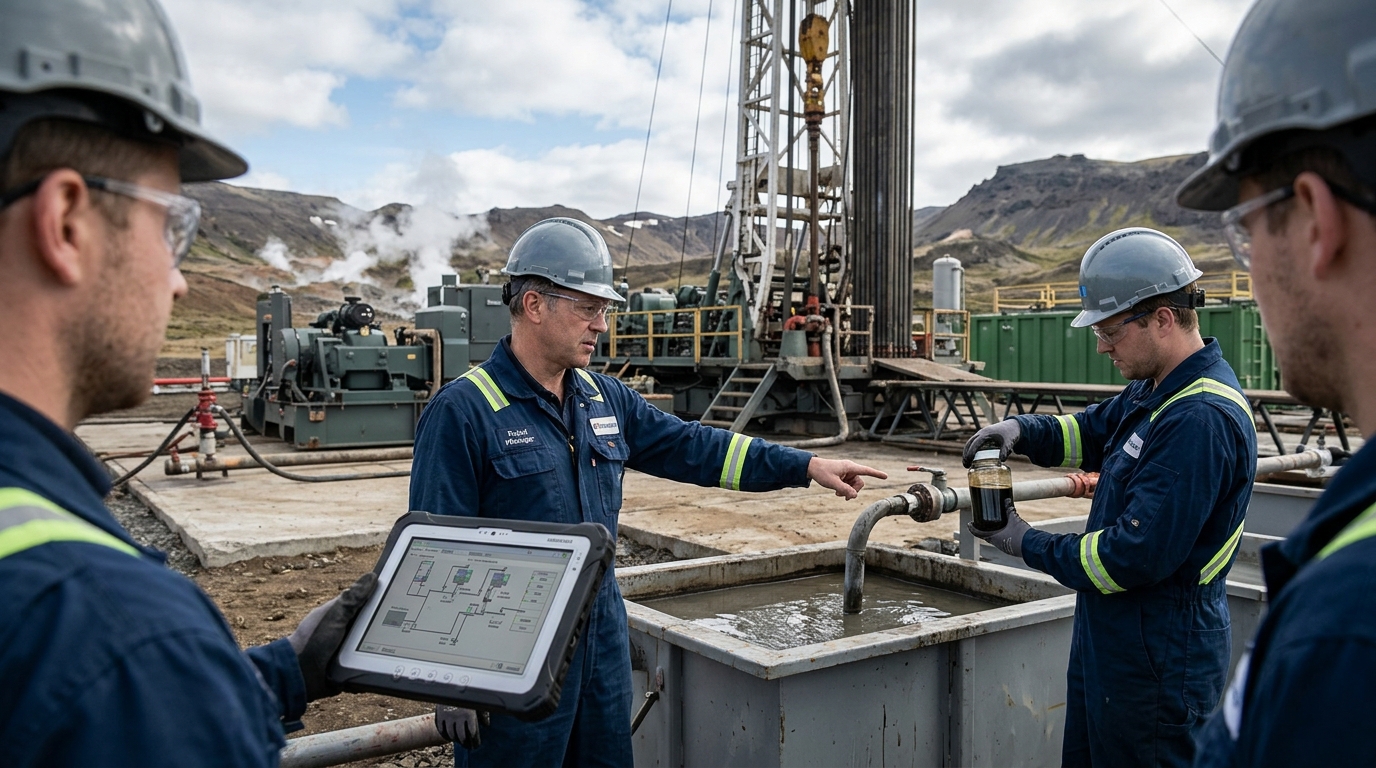
SLB closed at $53.06 on October 23, up 7% after beating third-quarter estimates, and the coverage cycle immediately fixated on the obvious: Production Systems, the ChampionX integration, sequential margin expansion. What most traders glossed over is the division where the longer-term geothermal story lives. Well Construction generated $2.89 billion in Q3 revenue, up 5% sequentially, and the company specifically flagged stronger drilling fluids sales as a primary driver.
That detail matters more than it looks.
The geothermal industry is pressing into temperatures where standard equipment simply fails. Conventional biopolymers used in drilling fluids break down below 300 degrees Fahrenheit. Standard directional drilling electronics are often limited to sustained operation above roughly 150 to 175°C, which forces workarounds as temperatures climb. At the IADC Geothermal Drilling Conference scheduled for November 17 to 18, presenters are tackling applications where operating temperatures can exceed 500°C, where today’s drill string designs are being pushed to their thermal and fatigue limits. This is not a theoretical boundary. It is where the next wave of geothermal capacity either gets unlocked or stalls.
SLB’s answer is VeraTherm, the water-based drilling fluid developed through its M-I SWACO division. The fluid has been documented by SLB as remaining stable for days at 375°F. SLB has deployed aqueous drilling fluids in more than 100 geothermal wells since 2015. Its specialized cementing systems, FlexSTONE and ThermaSTONE, extend the same thermal durability logic to wellbore integrity after the drill bit comes out.
What traders should track is how this fluid chemistry translates into contracted revenue. SLB partnered with Ormat Technologies in October 2025 to fast-track enhanced geothermal systems development, with Desert Peak, Nevada selected as the preferred pilot location in June 2026. It is providing engineering design and integrated well construction services for DEEP Earth Energy’s geothermal project in Saskatchewan, which is described by the company as producing up to about 30 megawatts of baseload power in its initial phases. The Turkey agreement awarded in Q1 2026, covering a customized artificial lift solution for an operator’s geothermal portfolio, extends the relationship further down the asset life cycle.
None of these contracts individually move the needle on a $9.45 billion quarterly revenue base. That is precisely the point. Professional traders distinguish between a business that is building optionality and one that is chasing a theme. SLB’s geothermal exposure is not a press release. It is a deployment record, a proprietary fluid formulation, and a growing string of long-duration service agreements that compound quietly inside a division most quarterly previews treat as background noise.
The broader lesson: when a company with SLB’s operational scale chooses to solve the hardest drilling chemistry problem in geothermal, and then signs contracts that put that solution into the ground, the financial impact shows up in the same line item as routine oil and gas work. Separating what is structural from what is cyclical inside a revenue segment is the skill that separates a trader who understands a business from one who is just reading a price chart.
The stock’s 52-week range runs from $34.65 to $60.46. At $53 it is pricing recovery in oil services. It is not yet pricing what a commercially proven high-temperature fluid system is worth when the geothermal drilling cycle actually accelerates.