
Editor’s Note: Over the past 20 years, Matt McCall has written up 50 stocks before they soared tenfold or more. Today he’s giving away a favorite new pick, free… at the center of what Dr. Mark Skousen calls “the most dangerous boom in history.” Click here to get the full details or read more below.
Dear Reader,
I recently sat down with Dr. Mark Skousen…
And he told me something that contradicts just about EVERYTHING we’ve been hearing about the stock market.
In short…
He says an astounding amount of money could flood into the markets in the years ahead.
We’re talking $60 trillion in new wealth up for grabs between now and 2029.
In my career, I’ve found 50 stocks before they soared tenfold or more.
(Most investors are lucky to see one ten-bagger in their lifetime.)
And I can tell you flat out…
I’ve never been more excited for what’s coming than I am right now.
See why here!
And as a special thank you for watching, you’ll get one of my favorite picks.
Regards,
Matt McCall
Editor, McCall’s Innovation Report
Apple Surpassed Nvidia. The Trade That Got It There Is Flipping.
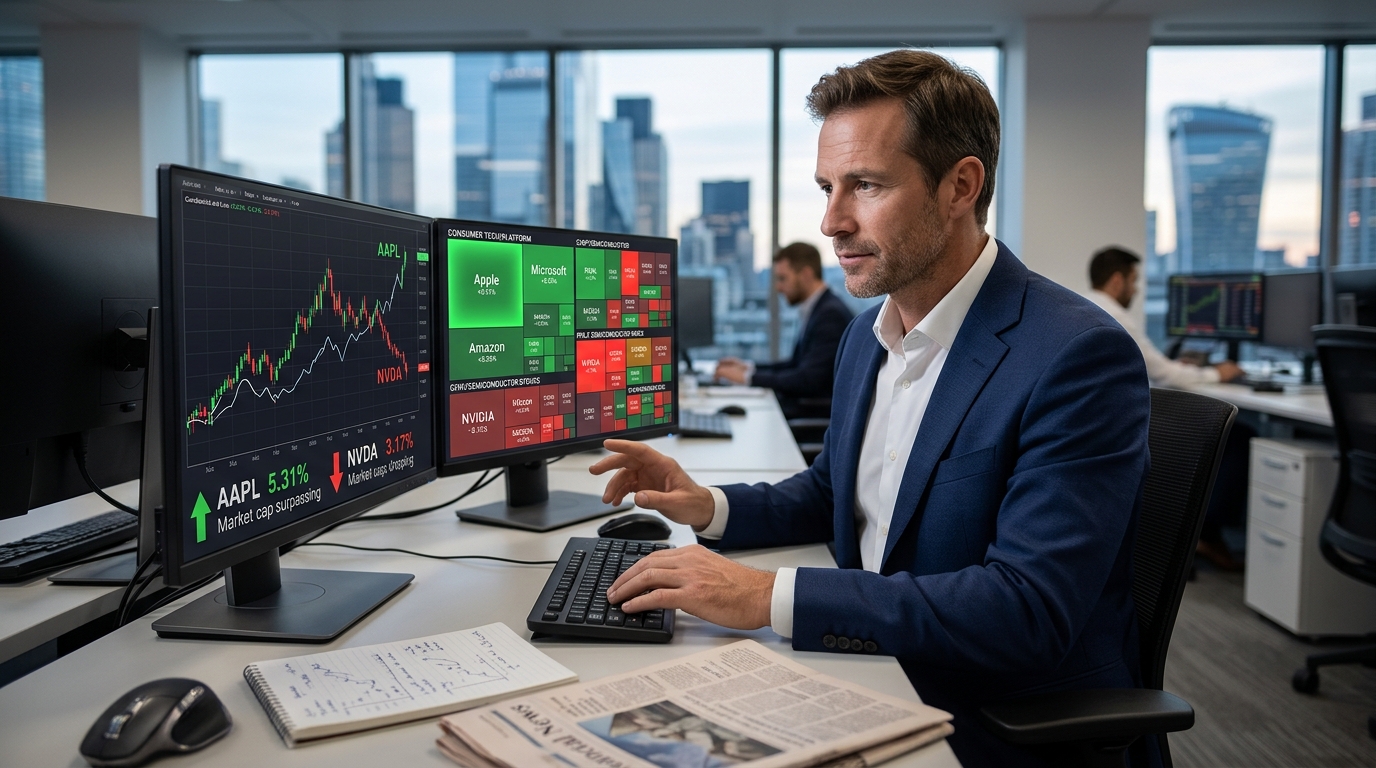
Wednesday’s session handed traders one of the cleaner rotation signals in recent memory. Apple rose 5.31% to a record close of $349.51, lifting its market value to about $5.1 trillion and displacing Nvidia as the world’s most valuable listed company. Microsoft added 6.68%. Amazon climbed 6.12%. Nvidia dropped 3.17%. Micron fell about 7%. SanDisk lost nearly 8%. The PHLX Semiconductor Index gave back about 3.1% while the Dow gained about 3%.
The same session. Opposite directions. That is not noise.
What Happened
Democrats won control of both chambers of Congress on November 3, and the market’s first full trading day in response produced a clean split between the companies that build AI infrastructure and the companies that consume it. Several outlets reported that data center-related stocks came under pressure after Democrats won big, and Democrat Gina Hinojosa, who campaigned on pausing new data center approvals, won the Texas governor’s race. A tracker of local ballot measures found that, among measures with reported results, the side limiting data center development won virtually all of them.
Democrats’ control of both chambers and their victories in key data-center regions brought into focus the concern that permits for new data centers and their construction could be restricted, and that if companies shoulder more of the costs of expanding the power grid and new investment is delayed, demand for suppliers of AI infrastructure, including memory, could also come under pressure.
Why It Happened
The logic traders applied was straightforward, even if the outcome plays out slowly: fewer data centers means less demand for the chips that fill them. Chipmakers already generating profits were seen as facing constraints on future earnings, while hyperscalers with weak cash flow were seen as likely to benefit if projects are delayed.
For Apple specifically, the read is about cost. High-bandwidth memory and NAND have been squeezing hardware margins across the industry. The decline in memory stocks came a day after memory stocks had gained following comments from Apple CEO John Ternus, who described the current memory-pricing environment as “unprecedented.” If a slower build-out softens that pricing pressure, Apple’s bill of materials gets cheaper. That is the inverse of the trade that made Nvidia the world’s most valuable company in the first place.
Amazon, Microsoft, Alphabet and Meta added about $653 billion of market value between them in the session, roughly 4.4 times the net $149 billion that Nvidia, Micron, Broadcom, Intel and AMD lost. The asymmetry matters: capital did not flee tech. It rotated within it.
The rotation’s losers share a common vulnerability. SK Hynix, Samsung, and Micron control over 90% of global DRAM production and have bet their capacity on AI data center demand continuing to accelerate.
How Professionals Might View It
Disciplined traders recognize that the most dangerous moment in a rotation is at the edges. For investors, the session marked a reversal after weeks in which the market questioned whether the returns on AI data centers would justify the outlays. That skepticism had been building. Wednesday gave it a political catalyst.
The professional question is whether Wednesday was a one-day reset of valuations or the beginning of a sustained leadership change. Wells Fargo Investment Institute noted that Democratic control could slow the push for deregulation, while also arguing that both parties have an incentive to compromise on data center location and AI generally. That hedged view suggests the rotation is real but the magnitude is unclear. Chasing either side of the trade aggressively at these levels carries positioning risk.
Trading volume in Apple on November 4 reached nearly 89 million shares, more than double its recent average daily volume of about 40 to 42 million. That is institutional participation, not retail enthusiasm. Someone large was putting money to work.
What Comes Next
Nvidia’s fiscal third-quarter results call is set for November 17. That report will be the first real test of whether Wednesday’s move was grounded in something fundamental or simply a political knee-jerk. If Nvidia’s data center order book remains strong, the gap between its stock and Apple’s could close quickly.
South Korea’s KOSPI plunged as much as 5% in early trading Thursday, led by steep losses in its two largest memory chipmakers, with SK Hynix and Samsung Electronics falling about 7% to 9%. That is the rotation going global. Watch whether those losses stabilize or deepen, because Asian memory pricing tends to lead where Micron’s margins follow.
The Trader’s Lesson
Yesterday’s leadership is not today’s enemy, but it is today’s competition for capital. The two-year trade that powered Nvidia and the memory complex ran on a simple premise: AI spending would only accelerate. Wednesday introduced a reason to question that rate of acceleration, and capital moved before the evidence arrived. That is how markets work.
When a rotation is this clean, buyers and sellers defined by a single macro theme, volume confirming the move, the right response is not to predict how long it lasts. It is to identify what would have to be true for it to reverse, and watch for those conditions. For this trade, the answer is straightforward: Nvidia’s November 17 earnings call.