
This could be the perfect stock to own right now…
[BLURRED OUT PREDICTIVE ALPHA CHART]
Now that’s not my opinion.
In fact, it isn’t based on anyone’s emotion, gut feeling, or analysis.
It’s based on cold hard numbers.
That’s because this stock wasn’t picked by an analyst.
It comes straight from the latest, most advanced AI model put out by a firm whose work has been seen on CNN, CNBC, in Forbes and the Wall Street Journal.
For their ability to use quant systems to achieve results normally reserved for only the most elite hedge funds on Wall Street.
Now their latest AI forecasts the price of over 2,334 stocks and 125 ETFs… up to 21 days in the future… to the penny.
With a historical accuracy of 73%.
This AI recently picked up trades in historical testing that would have given you…
- 31% on Ciena Corp
- 24% on Lumentum Holdings
- 45% on Western Digital Corp
- 47% on Micron
- 30% on Coherent
That’s five double digit winners… in one month… with NO LOSSES.
Today, I’d like to share its latest projection with you for free.
Not only that, I’ve put together a brief demo of how anyone can get started using AI to find high conviction trades every day of the year.
That’s because I believe if you’re not adding AI to every investment decision you make, you’ll miss out on the biggest potential gains in the market and fall so far behind you’ll be like a man still using a fax machine to communicate.
If you don’t act now…
Soon, EVERYONE will be using AI except you.
But today you have a historic opportunity to gain a huge advantage in the markets.
See its latest projection free – then forecast one stock of your own here.
To your wealth,
Keith Kaplan
CEO, TradeSmith
Linde’s $66 Billion Contract Wall Is What Buyers Want
Most conversations about Linde end with green hydrogen. That framing misses what disciplined money is actually pricing in as the calendar turns to Q4.
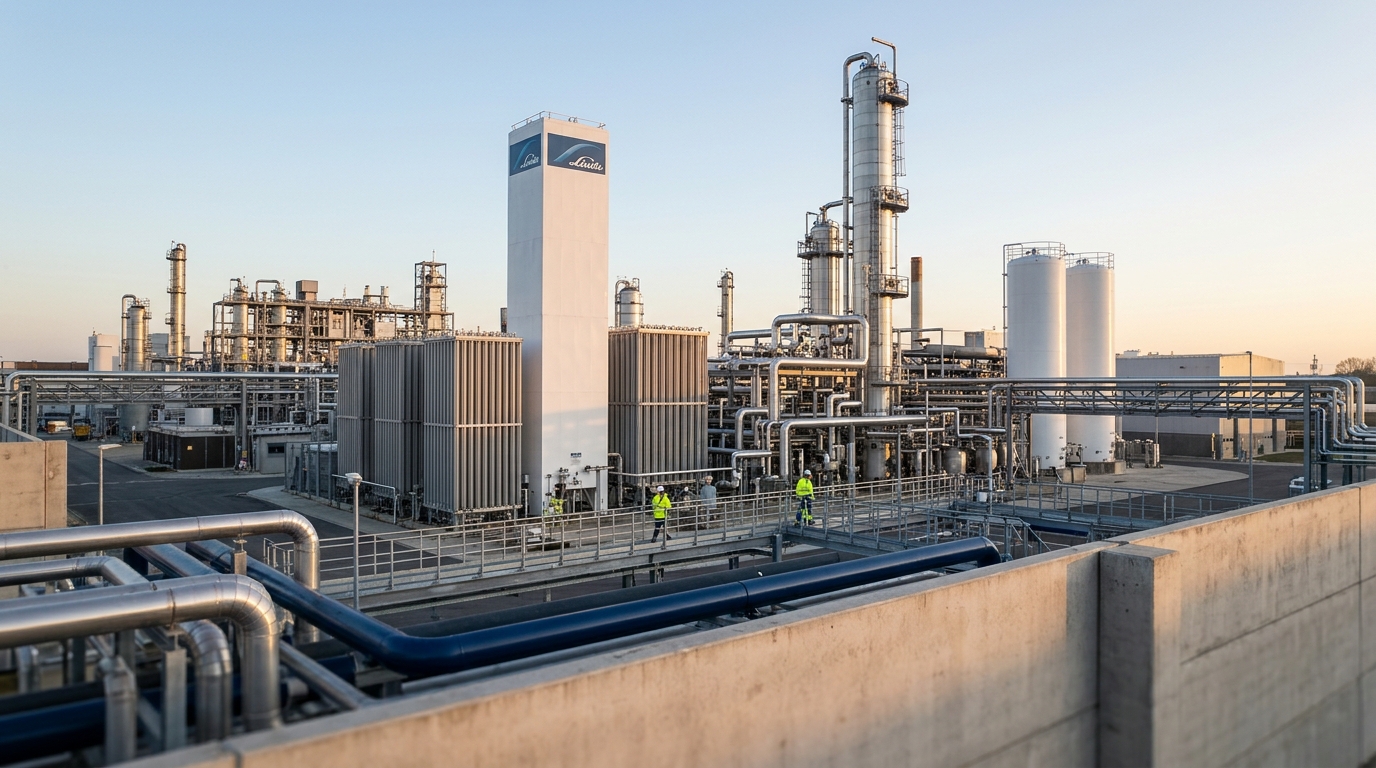
Strip away the energy-transition language and what you find at the core of LIN is a contractual revenue floor that few industrial businesses can match. As of September 30, 2026, Linde carried approximately $66 billion in remaining performance obligations tied to minimum purchase requirements and plant sales. That figure was approximately $62 billion as of December 31, 2025. It does not include any gas sold above contracted minimums, which can be substantial.
The contracts behind that number are not short-cycle agreements. On-site supply arrangements typically run 10 to 20 years, carry take-or-pay minimums, and embed price escalators tied to inflation. When a customer signs one, Linde builds a dedicated air-separation or hydrogen unit on their site. The customer then pays whether they use the gas or not. That is the structural reason LIN behaves differently from other industrials when growth fears rise: the revenue does not wait on the economy to cooperate.
The Q3 results posted October 29 reinforced that picture. Record quarterly sales of $9.4 billion came in 9% above last year, adjusted EPS of $4.59 exceeded consensus by about $0.07, and operating cash flow reached $3.2 billion. Full-year guidance was lifted to $17.82 to $17.92 in adjusted EPS, implying 8% to 9% growth. Capital expenditures of $5.5 billion to $6 billion are going directly into the project backlog, which management said sits close to $8 billion on a sale-of-gas basis headed into year-end.
Electronics is the loudest growth engine right now. CEO Sanjiv Lamba said on the earnings call that roughly $2 billion of backlog projects are already under execution, with staggered startups over the next two to three years. On July 31, Linde announced a $1 billion commitment to expand its Phoenix semiconductor gas complex under a new long-term agreement with one of the world’s largest chip manufacturers, with a parallel Taiwan award through its Linde LienHwa joint venture. That is not green-hydrogen speculation. It is contracted, capital-deployed, infrastructure already being built.
The semiconductor buildout driving Linde’s Phoenix expansion runs through a single manufacturing chokepoint. TSMC is the foundry that actually produces the advanced chips requiring the specialty gases Linde is contracted to supply.
What experienced traders recognize here is a business that behaves like a toll road. Industrial gases is effectively a global oligopoly, and most of Linde’s revenue compounds through fixed escalators regardless of what the broader market does in November or December. The stock is not cheap on any simple multiple, but capital flowing into LIN into year-end is not making a valuation argument. It is buying duration, contract visibility, and an earnings base that does not require a macro tailwind to grow.
The Trader’s Lesson
Defensive capital at year-end does not always mean buying utilities or consumer staples. Sometimes the most defensible position is a business with a $66 billion contractual revenue floor. The question worth asking about any position you hold into December is whether its earnings depend on conditions being favorable, or whether they arrive regardless. Linde’s answer to that question is what makes it worth watching right now.