
Hey Reader,
Ready for a pop quiz?
Thanks to a little-known investment secret…
One man was able to build a single $1,000 investment into a $70,000 income stream – after 60 years – without touching a single stock!

Click Here to Reveal the Answer!
Listen…
It doesn’t matter whether you get it right or wrong…
What matters is that you go here now for the answer.
Because I’ve just uncovered a similar opportunity that could help YOU collect double-digit income from this very sector for yourself.
As of right now, it’s still virtually unknown.
But I don’t expect it to stay that way for long.
So if you want a first mover advantage, you need to check it out ASAP.
Good investing,
Marc Lichtenfeld
Chief Income Strategist, The Oxford Club
P.S. I’d guess only 1 in 100 readers will get this right. And I’m curious if that’ll be you. Find out here.
When the AI Trade Breaks, Suppliers Get Hit Hardest
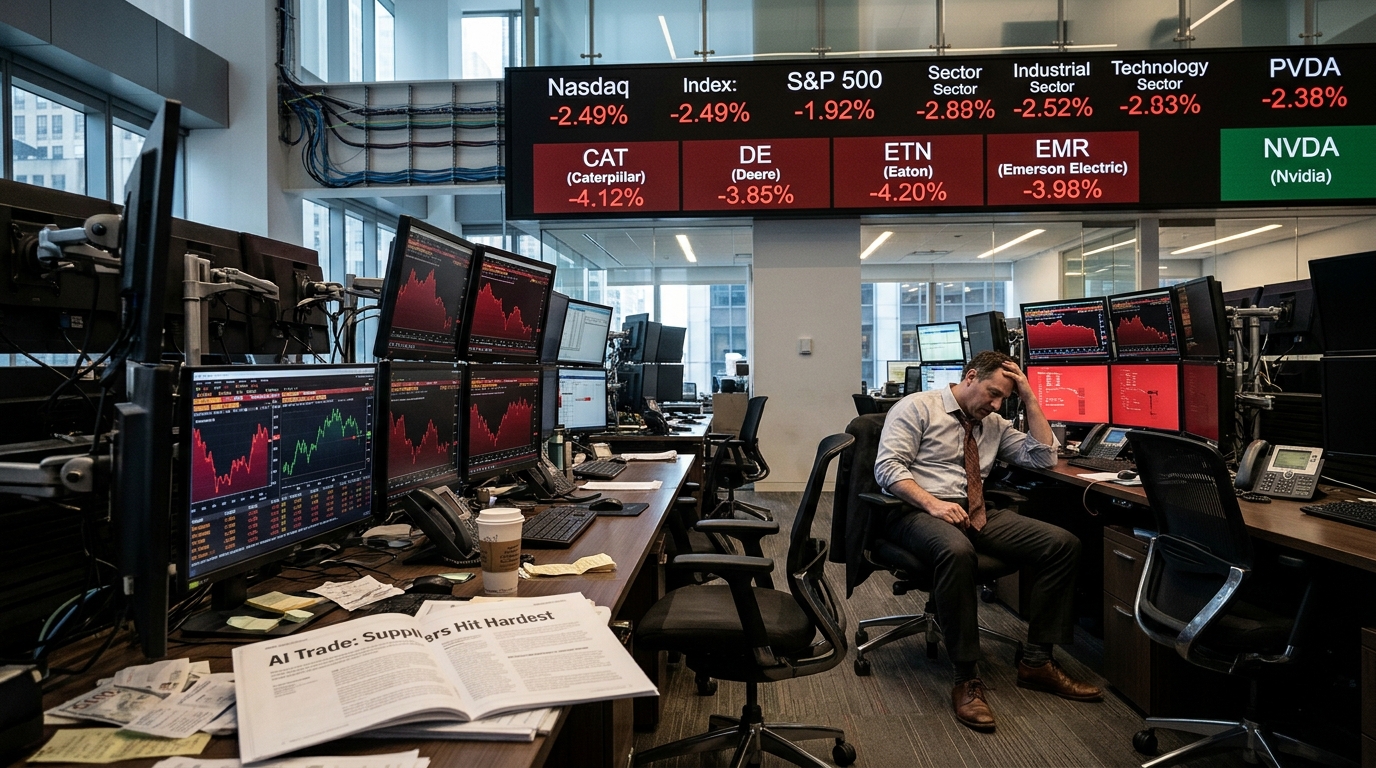
The Nasdaq’s third straight losing session on Monday carried a lesson that experienced traders know well: when a crowded theme cracks, the second-derivative names absorb the worst of it. The S&P 500 declined 145 points, or 1.92%, to close at 7,416.59, while the Nasdaq fell 626 points, or 2.49%, to 24,509.76. Nvidia drew the headlines, but it wasn’t the most damaged name on the screen.
Photonics stock Lumentum dropped 8.48%. Memory maker SanDisk fell 8.6%, while chipmaker Intel and data center power stock Bloom Energy declined more than 6%. Among Dow components, Caterpillar dropped 4.95%. These aren’t semiconductor fabs or GPU designers. They are the picks-and-shovels layer: the companies whose revenue case was built entirely on the assumption that AI infrastructure spending would keep expanding. Once that assumption wobbled, the trade unwound from the outside in.
Why the Suppliers Absorb More Pain
Nvidia at least has earnings to defend itself with. Its own AI chip revenue is real and recurring. The second-derivative names have something harder to price: the expectation that Nvidia’s customers keep ordering at the same pace. The 8.6% decline in SanDisk on Monday was not a one-off: the stock is down 37.7% over the past month. Lumentum appears on both the one-day and one-month losers lists, falling 8.48% Monday and down 33.7% over the past month. These are not corrections. They are deratings. The market is resetting the duration and reliability of AI-driven demand, and doing it most aggressively in the names with the highest thematic leverage.
Caterpillar has fallen about 44% from its highs, a drawdown on par with some of its biggest declines over the past decade. That’s a staggering reversal for a company selling excavators and bulldozers, and it illustrates exactly how far valuation can drift when a theme becomes a consensus.
Burry’s Exit Is Worth Studying
Michael Burry had been short Caterpillar via put options since the second quarter. He reduced his bearish position by 75% after his put options roughly quadrupled in value, according to a post in his Cassandra Unchained newsletter on Substack. He framed it as taking gains as the move matured, with the options having done their work. Knowing when a trade has played out is a separate skill from knowing when to enter.
Caterpillar is now about 46% below its late-June high. DA Davidson lowered its price target to $685 from $882 but kept a Neutral rating. The street isn’t capitulating. It’s recalibrating, which suggests the volatility in these names isn’t finished.
Caterpillar is not the only picks-and-shovels name to discover how fast a crowded trade can reverse. Seagate and Western Digital fell more than 10% in a single session when a single competitor headline punctured the storage supply thesis.
What Comes Next
Nvidia’s Q3 earnings report is due after market close Tuesday, November 17. That becomes the fulcrum for every AI-adjacent name still standing. A clean beat with strong forward guidance could stabilize Lumentum, SanDisk, and Bloom Energy quickly. Any further sign of demand hesitation from Nvidia’s hyperscaler customers would extend the pain into the broader supplier group.
Oracle fell roughly 5% Monday and belongs in the same frame. Its data center commitments have made it a de facto AI infrastructure proxy, and it carries the same risk: valuation built on a build-out that the market is now interrogating rather than celebrating.
The Trader’s Lesson
Thematic crowding is most dangerous not at the center of the trade but at its edges. When the core name stalls, the market doesn’t just sell that name. It questions the entire logic, and the highest-leverage, least-liquid expressions of that logic get hit the hardest and fastest. Caterpillar selling excavators to data center contractors, Lumentum supplying optical interconnects, SanDisk making storage for AI workloads: each was a reasonable idea. All three became crowded at the same time, for the same reason. That’s the condition that turns a correction into a rout. Identify your thematic exposure across positions, not just within individual names, before the leader stops working.