
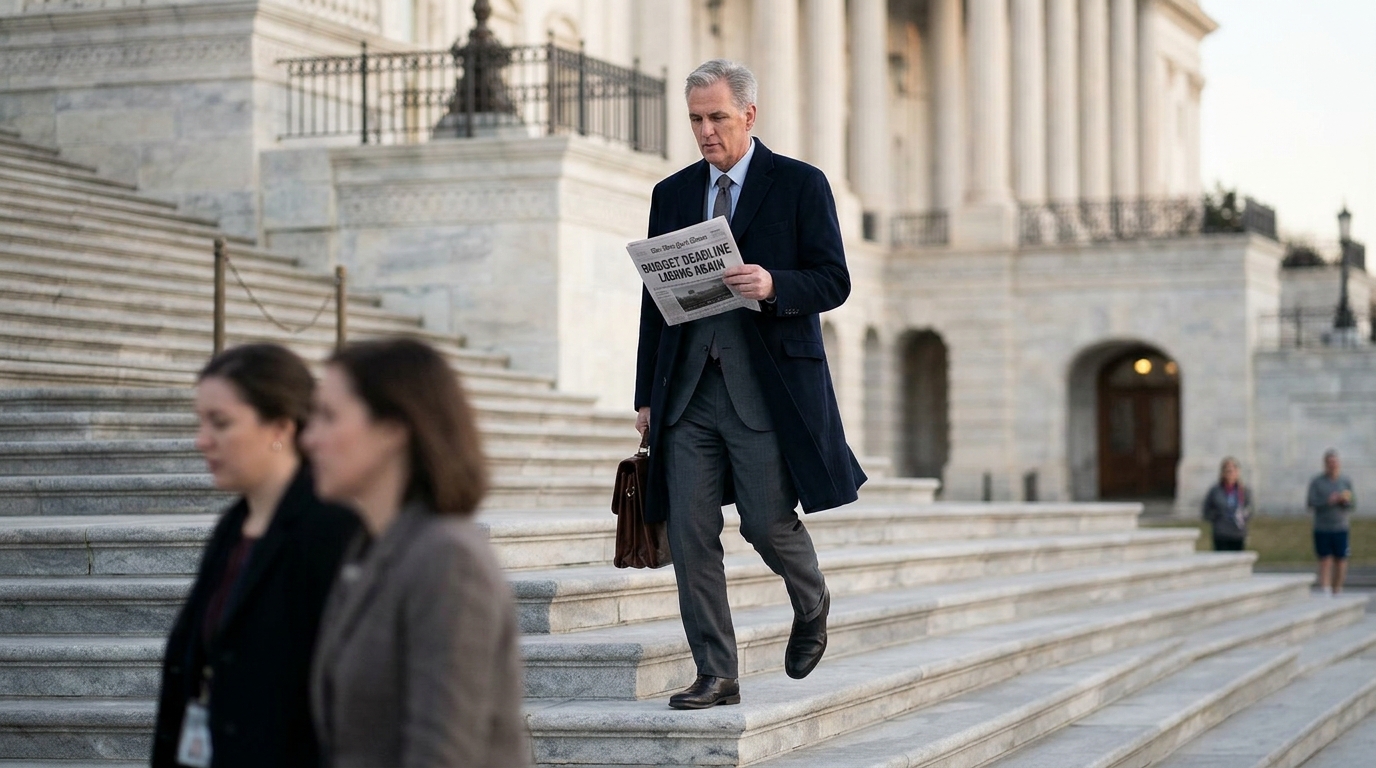
Congress comes back from its Thanksgiving break this week facing a wall it has refused to climb all year. The current continuing resolution expires December 11, 2026. None of the 12 annual spending bills has been enacted into full-year funding. If nothing changes, a funding gap begins on Saturday, December 12.
This would be the third shutdown of the current fiscal cycle. The US already underwent two partial shutdowns in 2026: the first lasting three days, from January 31 to February 3, and the second lasting 76 days, from February 14 to April 30, becoming the longest shutdown of a single federal department in US history. Before those, a full government shutdown ran 42 full days beginning October 1, 2025, and ended November 12, 2025. The accumulated disruption is not abstract.
The timing makes December’s deadline more consequential than the typical funding fight. The next FOMC meeting runs December 8 to 9, 2026, and it is one of the four meetings each year that comes with fresh economic projections. A funding lapse starting December 12 would arrive the day after the Fed’s decision, with the central bank just having committed to a path based on data it may no longer receive. The experience of the 2025 shutdown is instructive: that shutdown suspended key federal data releases at a pivotal juncture, complicating decision-making for Fed policymakers, investors, and business leaders in an increasingly data-dependent environment. When that shutdown suspended BLS operations, household survey data for October 2025 were not collected, and BLS did not issue an October 2025 Employment Situation report. A repeat, beginning just after the final FOMC of 2026, would force the Fed into early 2027 without a clean read on payrolls or inflation.
That is the genuine risk. The stock market, however, is a separate question, and the historical record here is surprisingly clear.
The S&P 500 decreased 8.6% last week, its worst week since April 2025. The Nasdaq Composite turned negative for the year, and the S&P 500 entered correction territory alongside the Dow Jones Industrial Average. Congress is adding a funding deadline to a market already searching for footing. The instinct to do something, to reduce exposure before December 11, is understandable. The data argues against it.
In past government shutdowns, the S&P 500 rose 57% of the time during the closure itself, generating an average return of 0.4%. Not one shutdown has caused a recession on its own, and shutdowns have not reliably coincided with major market downturns. The 2018 to 2019 shutdown, then the longest on record at 35 days, left the S&P 500 up roughly 10.3% from the close before it began.
One distinction matters: a routine funding shutdown and a debt-ceiling standoff are different risks entirely, and treating them the same is a common mistake investors make. A funding lapse pauses government services. A debt-ceiling breach would threaten the creditworthiness of Treasury securities, the foundation of global finance. Watch carefully for any sign the December negotiations bleed into debt-limit territory. That changes the analysis entirely.
For now, the opportunity is not in trying to trade around a congressional deadline. It is in using a week of correction-level selling to review whether a portfolio built for the long run is actually positioned that way. Defence contractors, which can see their payments delayed in a shutdown but not their underlying contracts, often recover once funding resumes. Treasury yields dipped last week as investors sought safety, compressing the entry cost for longer-duration bonds.
The single most durable lesson from every Washington funding fight of the past decade: the shutdown is the headline, not the thesis. Wealth is not built by fleeing markets every time Congress fails to do its basic job on schedule.