
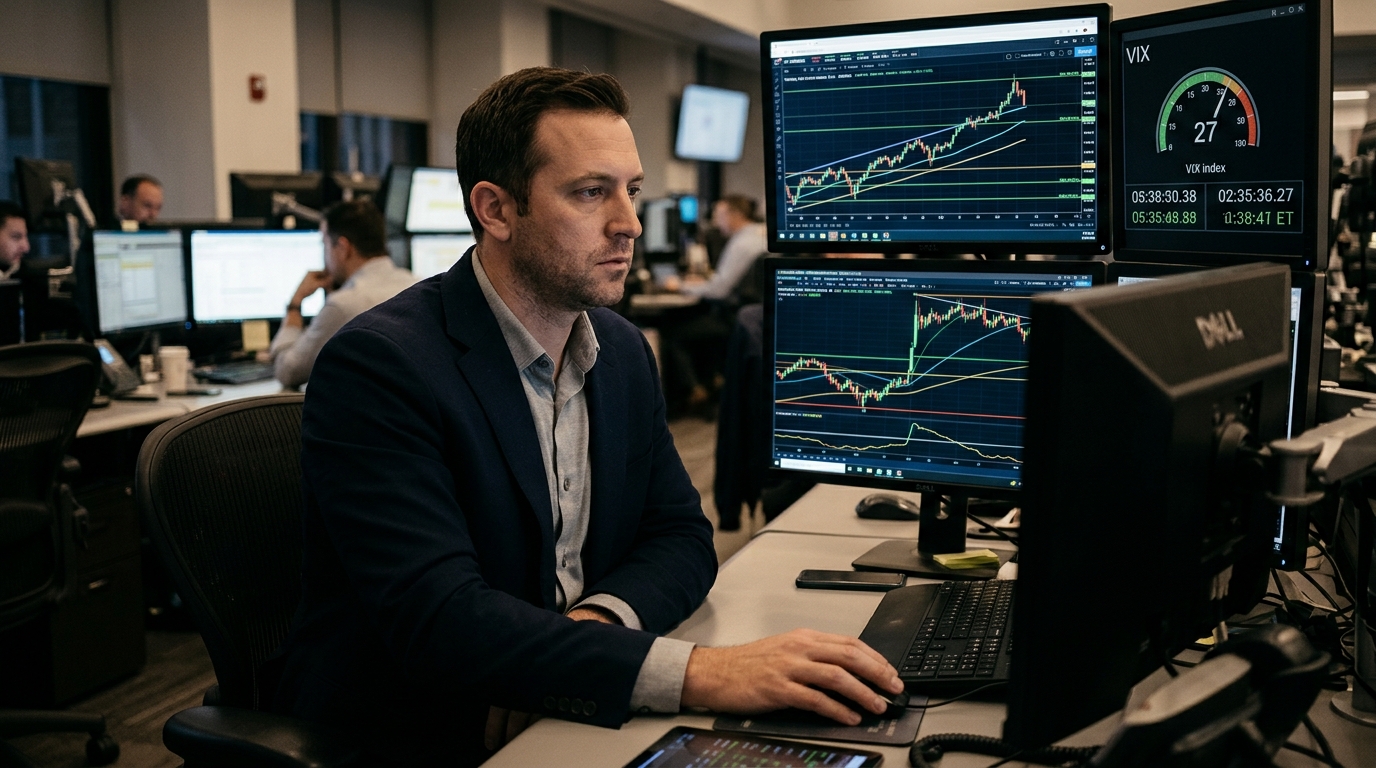
The opening gap will feel like vindication. US stock futures surged overnight, led by contracts tied to the Nasdaq 100, as investors returned from the Thanksgiving holiday with renewed appetite for beaten-down shares. Around 2 a.m. ET, Nasdaq 100 E-minis were up roughly 2.5%, with S&P 500 E-minis up roughly 1.5% to 2%. The price at open and the price you actually get are two different things, and in a 3.5-hour session, that gap matters more than usual.
Wall Street’s main indexes swung sharply this week after Jensen Huang returned as Nvidia CEO and Anthropic slid back toward its IPO price, with AI stocks seesawing as investors weigh more attractive valuations against persistent concerns about heavy spending on the technology. Both NVDA and ANT are central to today’s move. Investors faced intense volatility through the week, and AI stocks gave up gains as the week progressed, fanning worries that doubts about AI’s durability still persist. Pre-market indications pointed to gains in ANT and NVDA, but as one Reuters-cited analyst noted, “if these gains can be sustained on Friday, it would suggest that enthusiasm for the AI trade is back.” That conditional matters. Sustaining a futures-driven gap into a half-session with a near-27 VIX is harder than it sounds.
The Record Sitting on the Table
The NYSE reopens Friday for a half-day session that ends at 1:00 p.m. ET, and that session will decide whether the S&P 500 finishes its best Thanksgiving week since 2008. The index is up 3.94% this week with only today’s session remaining.
Context matters here: in the week ended November 20, the S&P 500 fell 8.61%, the Dow fell 8.02%, and the Nasdaq Composite fell 10.02%. The best Thanksgiving week of all time came in 2008, in the middle of the financial crisis, when the index jumped about 12%. This week is not 2008. It is a rebound within a bruised market, with the Fed still leaning hawkish. Data this week showed the US economy grew faster than previously estimated in the third quarter while inflation accelerated further in October, reinforcing expectations of a December rate hike, with CME FedWatch showing odds above 97% for a 25-basis-point move.
What the 1 O’Clock Close Actually Does
This is where execution separates disciplined traders from reactive ones. A shortened session that ends at 1:00 p.m. ET means thin volumes and prices that can move further than the news justifies. Volume on the post-holiday half session is typically thin as market participants stretch the long weekend, and lighter liquidity can amplify intraday price swings. Investors placing orders during the shortened Friday window may see wider spreads and less reliable fills.
The specific danger today: a 2.5% gap open in Nasdaq names with the VIX sitting near 26.8 compresses the entire day’s risk into 90 minutes of meaningful volume before the market thins out ahead of close. Anyone chasing NVDA or ANT at the open and expecting to manage the position through the afternoon needs to remember there is no afternoon. The bond market closes at 2 p.m. ET, but equity stops getting tested before that.
NVDA’s structural position has shifted well beyond chip sales. Nvidia’s move into data center lease guarantees means its risk profile now extends beyond the semiconductor cycle into long-duration infrastructure commitments.
Placing market orders during a half-day session exposes you to wide spreads and poor execution fills when liquidity is lowest. Carrying leveraged positions through extended closures leaves you exposed to gap risk you cannot manage while exchanges are shut. Whatever hits the screen at 12:59 p.m. ET today is what you carry into a full weekend before Monday’s open.
The Trader’s Lesson
Futures gaps are price discovery, not trading opportunities by themselves. The question is never whether the market is up 2% in the overnight session. The question is whether the structure of the session, 3.5 hours, elevated volatility, thin participation, and a hard close, gives you enough room to manage the position if the gap fades. Today it very possibly does not. Liquidity will be thin as traders return from the holiday, and the December Fed meeting is close enough to color every decision. After a week like this one, the temptation to guess the next big move is strong, and that is exactly when patience tends to pay. Let the record lock in on its own terms. The first trade of a new week on Monday costs nothing.