
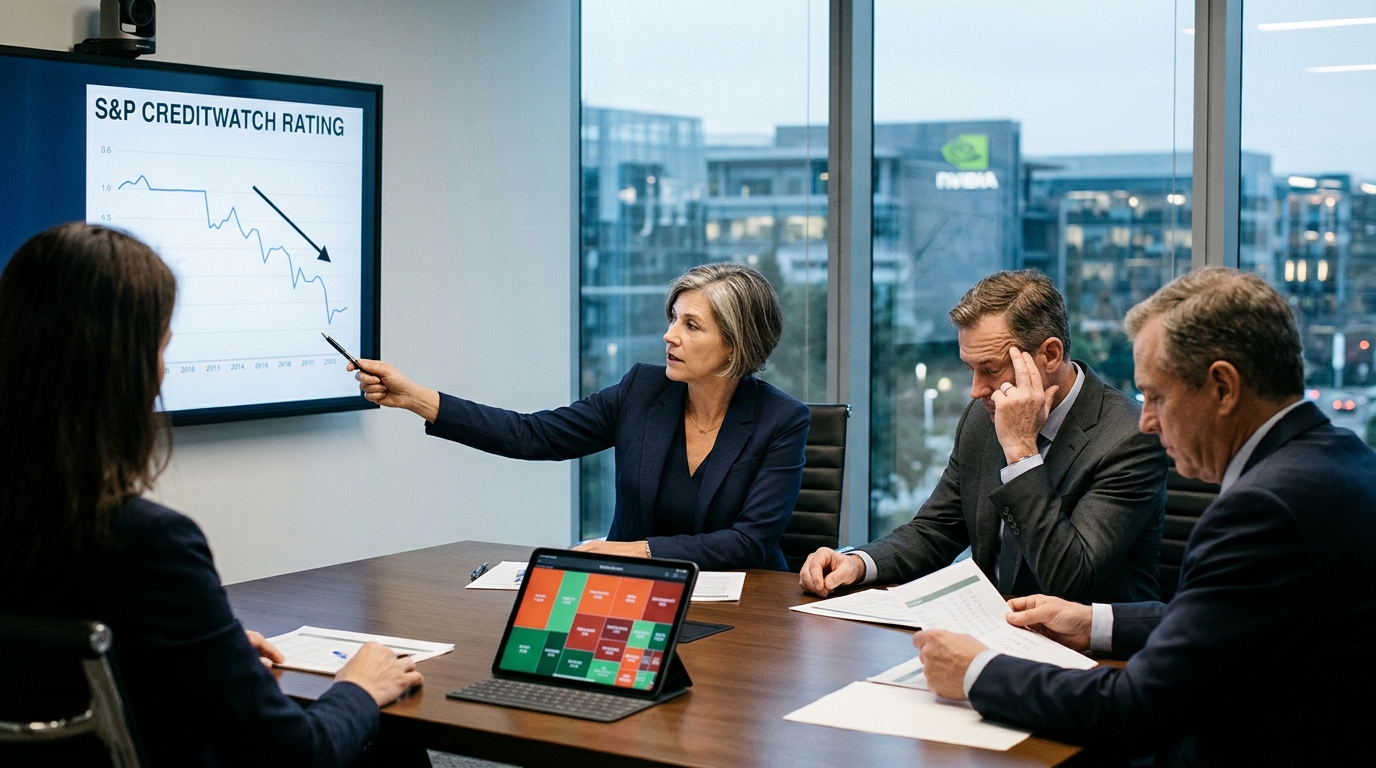
The debate inside every institutional investment committee this week is not whether Nvidia’s chips are still in demand. Dell’s AI server backlog ended the quarter at a record $132.3 billion, and Dell said it booked $60.2 billion of AI orders last quarter. The business case is intact. The governance case is not, and S&P Global Ratings has now said so formally.
S&P Global Ratings placed Nvidia’s AA issuer credit rating on CreditWatch with negative implications on November 25, 2026, signaling a downgrade is likely within roughly 90 days. In its statement, S&P pointed to vulnerabilities tied to board independence and oversight, key-person risk driven by the lack of a formal succession plan, and the company’s ability to manage geopolitical and export-control related risks. As a result, S&P cut its assessment of Nvidia’s management and governance to neutral from positive.
What makes this action distinct from Moody’s earlier move is the target. S&P’s watch placement focuses on management and governance risk stemming from the resignation and reinstatement of CEO Jensen Huang, not Nvidia’s operating results. Moody’s, which rates Nvidia at Aa1, moved its outlook to stable from positive on November 18, 2026, citing the CEO transition risk and the lack of a formal succession plan, while affirming the rating. The two agencies looked at the same governance stress and reached meaningfully different conclusions. That divergence is precisely what a portfolio manager should be sitting with right now.
The sequence that triggered S&P’s concern is striking: the board accepted Huang’s resignation on November 11, 2026, with CFO Colette Kress named interim CEO; the board then voted unanimously to reinstate Huang, effective immediately, announced on November 23, 2026 in a press release filed as an exhibit to a Form 8-K. The reinstatement came after President Trump repeatedly urged the board to bring Huang back, even as board chair Harvey Jones had said the company did not intend to reinstate him.
What happened next sharpened S&P’s concern rather than relieved it. S&P said the reinstatement alone does not answer its questions about board oversight and the durability of the company’s governance framework, including board independence and key-person risk. Huang co-founded Nvidia in 1993, and observers now question how independent the board really is. Board chair Harvey Jones has served on the board since 1993.
S&P said it expects any downgrade to be limited to one notch, to AA-, unless investigations or disclosures lead the agency to conclude that Nvidia’s reputation or future prospects have been harmed. S&P plans to meet with Nvidia’s board and management to discuss remedial steps. That meeting will tell investors far more than the CreditWatch placement itself.
Here is what institutional investors are underweighting. The governance discount being applied to Nvidia’s stock, which fell 3.91% to $149.30 on November 25, 2026 and sits roughly 38% below its October peak, is currently treated as a valuation reset tied to the CEO saga. But S&P has reframed it as a structural question about whether this board can exercise independent oversight of a founder-CEO, refuses succession planning, and operates at the center of an ongoing independent investigation. That investigation is unfinished, and the compliance organization the board is building around it is still forming.
The AI demand argument remains compelling. Nvidia posted quarterly revenue of $115.8 billion, up 103% year over year, with data center revenue of $107.6 billion. Nvidia also said Vera Rubin NVL72 has shipped, but the company has not disclosed that Vera Rubin generated nearly $20 billion in its first production quarter. Several AI hyperscalers anticipate spending more in 2027, building on an already record-breaking 2026. None of that is in dispute.
What is in dispute is whether a board that reversed a CEO resignation in less than two weeks, partly under political pressure, can credibly oversee the man who built the company. S&P has put that question on a 90-day clock. For long-only managers who bought the dip as a business story, that clock is now ticking on something they did not price.
Stocks to Watch
- Nvidia (NVDA): The core subject. The CreditWatch placement raises borrowing costs at the margin and could restrict Nvidia’s flexibility in financing large customer programs. Watch the board’s response to S&P’s forthcoming governance meeting as the clearest signal of how seriously remediation is being taken.
- Dell Technologies (DELL): Dell builds full AI server racks, many of them around Nvidia’s chips, and booked $60.2 billion of AI orders last quarter. Any governance-driven disruption to Nvidia’s customer relationships would flow directly to Dell’s pipeline.
- Broadcom (AVGO): Supplies networking silicon that runs alongside Nvidia’s GPUs in large AI clusters. A prolonged Nvidia governance overhang that cools hyperscaler confidence could accelerate custom silicon programs at the major cloud providers, which are already Broadcom’s biggest growth opportunity.
- Microsoft (MSFT): As one of Nvidia’s largest customers for AI infrastructure, Microsoft faces direct concentration risk if Nvidia’s governance situation lengthens uncertainty around export compliance and China disclosures, two of the areas S&P flagged.