
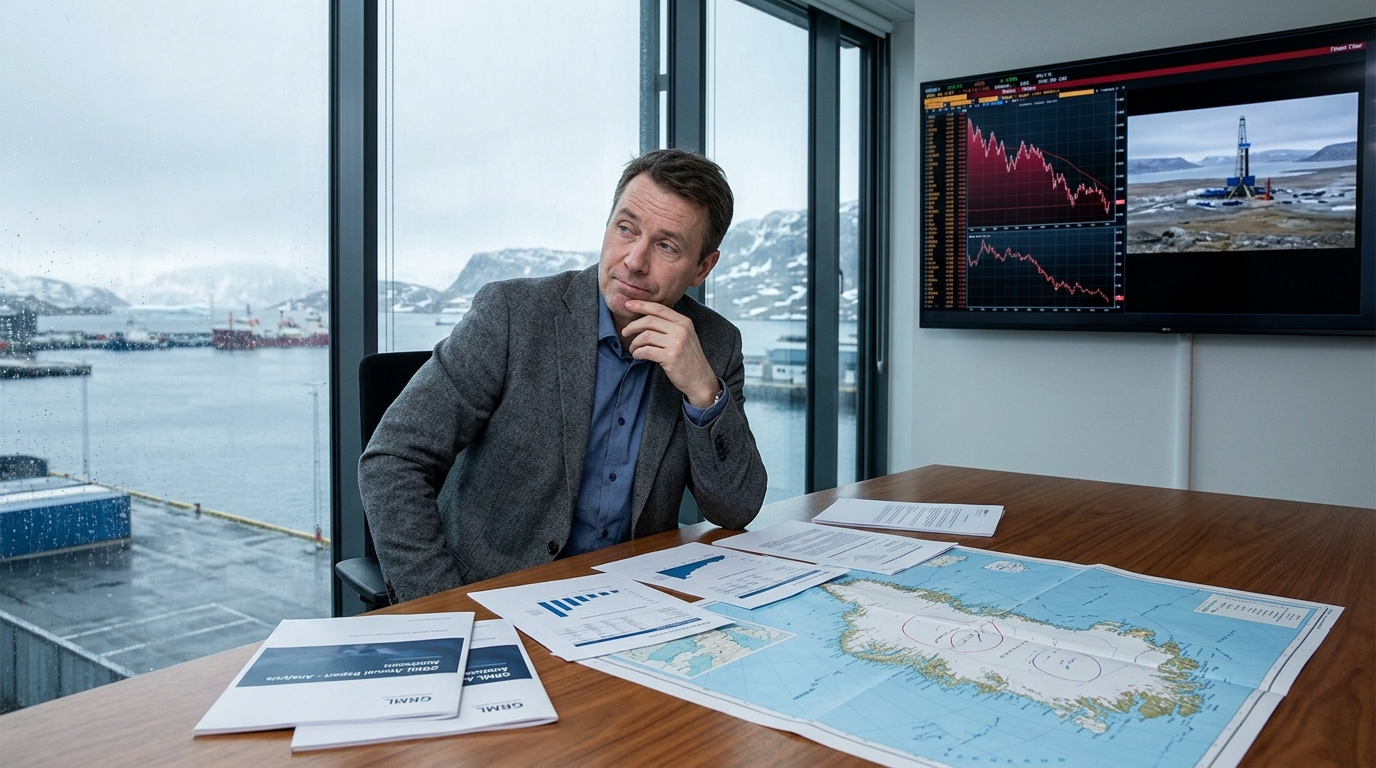
President Trump posted on Truth Social Wednesday that “massive” oil, gas and mineral exploration is getting ready to begin in Greenland. No timeline, no named project, no contract. Just a claim, and an enormous one, pitched to a market that has already tried to price Greenland euphoria once this year and lost.
The real question for investors is whether any listed company can actually convert this headline into revenue, and whether the risk-reward makes sense at current prices.
The Business Case for Greenland Minerals
Greenland holds approximately 6.7 billion barrels of oil equivalent in mean risked recoverable resources in the northeast, and significant deposits of rare earth elements, lithium, graphite, nickel, cobalt and copper, though much of the mineral potential remains underexplored. The geopolitical logic behind Trump’s focus is straightforward: the Trump administration says it wants to reduce reliance on Beijing for critical minerals.
The announcement follows the security agreement signed by the U.S., Greenland and Denmark on September 22, which references cooperation on minerals, economic development and business promotion but does not grant extraction rights or spell out specific projects. Mining companies read that language as a market signal. But it is still a signal, not a permit.
Why Wall Street Tried This Trade Before
The company that drew the most attention after the September agreement was Greenland Mines (Nasdaq: GRML), which has positioned itself to tap the Arctic island’s critical minerals and on September 1 closed its purchase of the Sarfartoq Nd-Pr Rare Earths Project in southwest Greenland. NdPr oxide is used in manufacturing magnets for EVs and wind turbines, and the company has pointed to a high-case pre-tax NPV of about $2.05 billion for Sarfartoq and an estimate that planned annual NdPr oxide output could represent roughly 34% of NdPr oxide refined outside China at 2025 consumption levels.
Days after the security agreement was announced, Greenland Mines said it applied on September 21 for a new license that would expand its Sarfartoq district footprint. That was the catalyst trade. Today, the stock sits near $5.54, down roughly 85% from its 52-week high of $36.99 set on March 4, 2026.
The Balance Sheet Problem
Here is where the thesis fractures. Greenland Mines is a pre-revenue, development-stage company. In its most recent quarterly filing (for the quarter ended June 30, 2026), it reported about $65 million in total assets, including roughly $48.7 million of property and equipment and about $10.0 million of cash. The same filing shows operating cash outflow of roughly $6.85 million for the quarter, and free cash flow of roughly negative $7.28 million, underscoring a high burn rate and ongoing dilution risk.
The dilution risk is not theoretical. The company raised more than $42 million through a registered direct offering of common stock and pre-funded warrants at $12 per share, and it also announced a Frankfurt Stock Exchange listing intended to broaden European investor access. Separately, SRX Global told shareholders it was liquidating its Greenland Mines holding as part of re-positioning its portfolio.
What Could Go Wrong
Trump’s announcement carries a structural problem that the market has not yet fully priced. Under existing legal arrangements, the United States has no independent authority to drill for oil in Greenland, and the September defense and security agreement does not grant American companies automatic exploration or extraction rights. Greenlandic law assigns Greenland Self-Government the right to exploit subsurface mineral resources. Since June 2021, Greenland’s government has maintained a policy of ceasing the issuance of new oil and gas licenses.
The oil story is especially constrained. Greenland Energy has postponed its planned oil drilling campaign in East Greenland until winter 2027 after project equipment was brought ashore without prior government approval. The setback affects exploration plans tied to the Jameson Land Basin, and Greenland’s government said the regulatory process cannot be completed in time. Trump’s enthusiasm does not override Nuuk’s permitting authority.
The Bottom Line
Trump’s post moves sentiment, not geology or regulatory timelines. Greenland Mines holds genuine assets in a jurisdiction that now carries Western strategic backing, and the Sarfartoq project’s stated $2.05 billion high-case pre-tax NPV dwarfs the company’s market value. That gap is what draws buyers in.
But the cash burn rate, persistent dilution, zero revenue, and Greenland’s own legal control over approvals make GRML a speculative position, not a quality compounder. If this morning’s Truth Social post triggers a sharp rally, it is a trading event, not a fundamental rerating. Disciplined investors should watch whether Greenland’s government responds with any concrete licensing signal before treating Trump’s words as a business catalyst.