
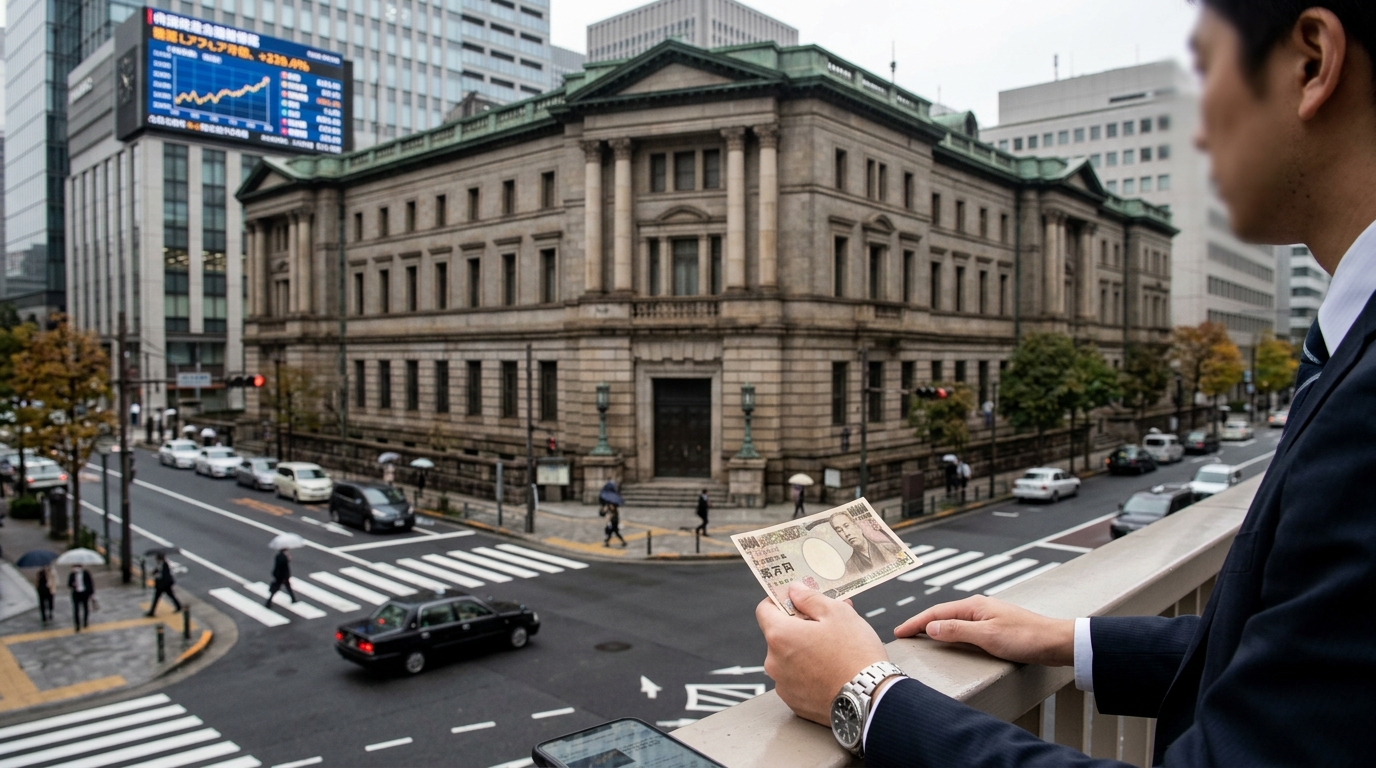
The most instructive thing about this morning’s Japanese producer price reading wasn’t the number itself. It was the gap between what the market expected and what actually arrived.
Corporate goods prices in Japan climbed 6.8% in September from a year earlier, slowing from 7.6% the prior month. The consensus had penciled in 7.6% again. On a monthly basis, the Producer Price Index fell 0.3%. That miss matters because it arrived at exactly the wrong moment for yen bulls and exactly the right moment for the Bank of Japan’s cautious wing.
What Happened
The data indicate that inflationary pressure from input costs may have peaked for now, reducing the urgency for the Bank of Japan to raise interest rates again immediately after last month’s hike.
Meanwhile, the global backdrop is moving in the opposite direction. The Fed raised rates by 25 basis points on September 16, its first hike since July 2023. Minutes from that meeting showed most participants judged another increase would likely be appropriate before year-end. The BoJ hiked last month too, but today’s data makes a back-to-back move from Tokyo far less likely. The next BoJ meeting is scheduled for October 29 and 30.
Why It Happened
The divergence is widening fast. The Fed sits at a target range of 3.75% to 4.00% and is signaling more. The BoJ, following last month’s hike, remains near 1.25%. That spread is wide enough to drive trucks through, and currency markets are living in it.
The Fed’s hawkish posture is not a short-term blip. Citi pushed its first Fed cut forecast all the way to mid-2027 after a stronger-than-expected jobs report reinforced the case for higher-for-longer rates.
USD/JPY traded around 158 on Tuesday. Over the past month the yen has weakened about 2.6%, and it’s down about 4.2% over the last 12 months. Traders remain on high alert for currency intervention from Japanese authorities to prop up the yen. The Takaichi government’s position complicates things further. The Japan Times reported this month that Prime Minister Sanae Takaichi has pledged to use long-term government spending to spur investment, pressing ahead with her “responsible, proactive fiscal policy” even as a weak yen and funding concerns cloud the outlook. Fiscal expansion and currency weakness tend to reinforce each other when monetary policy stays loose.
On the equity side, Japanese equities weakened significantly on October 13, with the Nikkei 225 down more than 2% in a pullback led by tech and semiconductor shares. That reaction tells you something: a softer PPI wasn’t read as unambiguously good news. Lower input costs help corporate margins, but a BoJ that stays on hold also means a yen that keeps drifting.
How Professionals Might View It
Disciplined traders focus on asymmetry. Right now, the yen carries an uncomfortable one: the BoJ needs both persistent inflation and a stable currency to justify hiking, but each day the Fed stays ahead, the currency weakens further. But “eventually” is not a catalyst. Positioning around BoJ expectations in this environment rewards patience over anticipation.
The yen is the instrument to watch. Prediction markets have put the odds of no change at the October meeting around 90%. That near-certainty is already priced in. What isn’t fully priced is what happens to USD/JPY if the Fed delivers in December and Tokyo is still standing pat.
The Trader’s Lesson
Policy divergence between major central banks rarely resolves quickly, and the currency that sits between two moving policy rates is often the most honest signal in the room. When one central bank gets permission to wait while another is hiking, the exchange rate does the talking. Watch what USD/JPY does in the days ahead, not as a simple indicator, but as the market’s running verdict on how long Tokyo can hold its ground.