
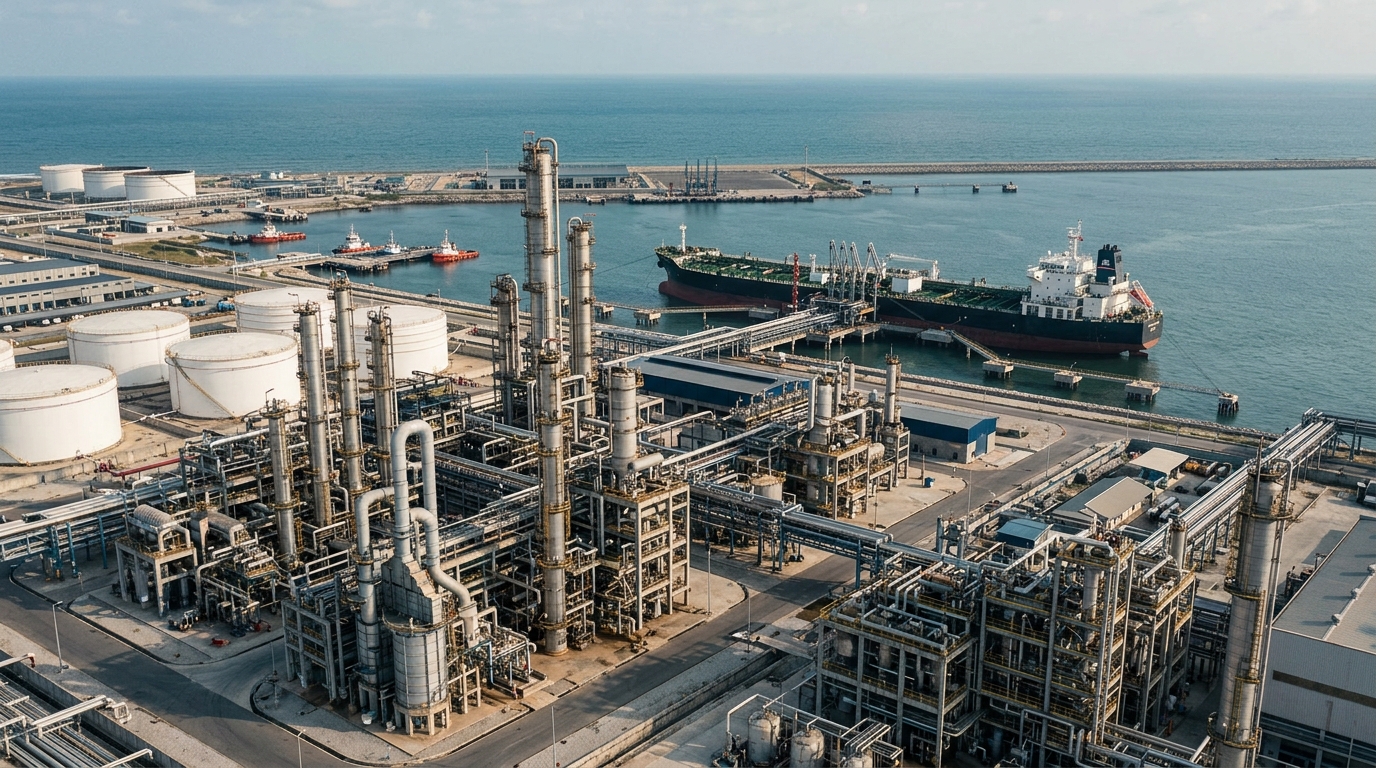
Subscriptions for the Dangote Petroleum Refinery and Petrochemicals IPO close Tuesday, October 13, 2026. The offer covers 4.1 billion shares at ₦525 each, targeting about ₦2.15 trillion. In its prospectus and related reporting, that has been described as roughly $1.6 billion at prevailing exchange rates. If successfully concluded, the transaction is being billed as Africa’s largest share sale to date. The timing is not incidental. This IPO is dropping into one of the most dislocated product markets on record, and that dislocation is precisely what makes the listing a risk event for U.S. refiners, not just an African capital market milestone.
The Diesel Market That Built This Story
The broad point still holds, diesel has been the tight barrel in this cycle. But some of the specific numbers in circulation are either dated to a different episode or are not consistently documented in primary sources. Rather than anchor this on a single historical “record” crack print, the cleaner framing is that U.S. diesel crack spreads have pushed above $100 per barrel at points in 2026, far above typical mid-cycle ranges.
Likewise, claims about “New York ULSD stocks” at a precise 8.9 million barrels, and U.S. diesel exports at 1.41 million b/d, depend on the exact week, geography definition, and data series. The underlying takeaway remains, inventories have been tight and exports have been high relative to normal, which is why diesel prices have looked disconnected from crude. The shortage is in refining capacity rather than crude supply. Before this kind of stress cycle, diesel cracks were typically in the teens to a few tens of dollars per barrel, not triple digits.
Amid unusually wide crack spreads, Valero, Marathon Petroleum, and Phillips 66 have benefited from a powerful earnings tailwind, plus buybacks and dividends. The Q2 numbers reflect how large the windfall has been. Marathon reported Q2 2026 net income of about $5.1 billion with a Refining & Marketing margin of $36.33 per barrel. Valero reported Q2 2026 net income of about $3.7 billion, and its refining margin per barrel has been widely cited around $23.62 for the quarter.
Why Lekki Changes the Calculation
Here is what the prospectus and recent trade data make clear, Dangote is not waiting for European demand to come to it. In September 2026 interviews, Dangote’s CEO said the refinery was at full capacity around 700,000 barrels a day, and Reuters reported the plant was prioritising diesel and aviation fuel for export as Middle East disruptions reshaped trade flows. Europe imported about 80,000 barrels a day of jet fuel from Dangote during the second quarter, according to Kpler. Reuters also reported, citing Kpler, that Dangote’s diesel and gasoil exports rose 23% year to date in 2026 to about 48,000 barrels a day.
On throughput, several reports describe Dangote running at a record roughly 660,000 b/d in May and June, and analysts have tied the ramp to a sharp drop in West Africa’s extra-regional clean-product imports, on the order of the low-to-mid 20% range. At full capacity, Dangote can produce the equivalent of up to 157,000 b/d of diesel and 125,800 b/d of jet fuel, according to company figures cited by S&P Global. That same reporting says Nigerian diesel consumption accounts for about 56% of its production potential, and local jet fuel demand is about a fifth of its capacity, meaning exports are structural, not opportunistic.
The Risk for U.S. Refiners
The bull case for Valero and Marathon rests on constrained global refining capacity keeping crack spreads elevated through at least the first half of 2027. That argument has real merit. But Dangote complicates the thesis in a specific way that the 2022 crack spread cycle did not, a single, low-cost, roughly 700,000-barrel-per-day complex is actively targeting the same European buyers U.S. refiners have been serving at unusually high margins.
Low production costs and a more balanced crude slate are turning Dangote into a durable exporter of jet fuel and diesel, even as European margins retreat from crisis highs. On expansion, Reuters and S&P Global reporting has discussed plans that would lift capacity from 650,000 b/d toward about 1.4 million b/d, tied to a multiyear buildout. If capacity does reach roughly 1.4 million barrels a day later this decade, the refinery will need customers far beyond Nigeria. The IPO, which closes tomorrow, is intended to raise fresh capital toward that broader plan.
Valero’s COO has argued the mid-cycle margin floor has shifted structurally higher. But “structurally higher” is not “permanently at $102.” Investors chasing today’s crack spread as a forever-trade are missing the cyclicality that has defined refining for decades. Dangote at full throttle is not the only reason crack spreads will eventually compress, but it is a large, growing, and increasingly export-oriented reason. Traders long Valero or Marathon on the margin story alone should be tracking Lekki throughput figures as closely as EIA inventory reports.