
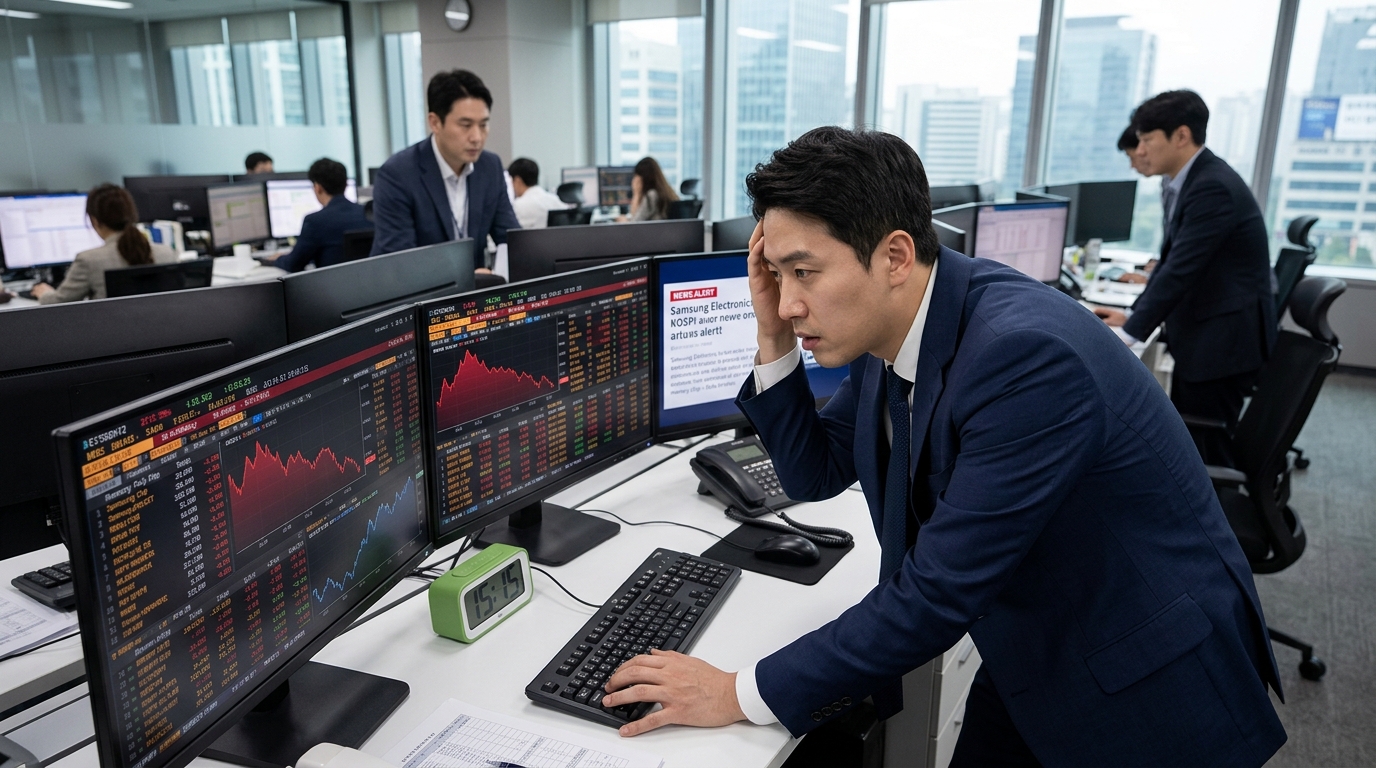
Monday’s session in Seoul handed traders a useful test: can you tell the difference between a geopolitical headline and a positioning unwind? Both hit the KOSPI today. Most investors lumped them together. That was a mistake.
What Happened
North Korea fired multiple ballistic missiles toward its eastern waters Monday, adding to a recent streak of weapons demonstrations that has heightened tensions during a prolonged freeze in diplomacy. South Korea’s Joint Chiefs of Staff detected the launches from the Pyongyang area around 9:20 a.m.; at least one missile flew more than 900 kilometers, about 559 miles. The JCS described it as a show of force in response to South Korea’s successful hypersonic missile test on October 8.
The KOSPI closed down 3.65% at 6,384.24, breaching the 6,400-point mark in heavy selling. Japanese cash equities markets were closed for a public holiday, thinning regional liquidity and amplifying every order that hit the book. Samsung Electronics finished down 4.39% at 250,500 won, while SK Hynix fell 4.52% to 1.605 million won.
Why It Happened
Here is where the two stories split.
The missile launches are real and they moved defence stocks. Hanwha Aerospace traded down to around 862,000 won during the session despite being, on paper, the kind of company that benefits from elevated regional threat levels. When even the defence names sell off on a missile headline, it signals broad risk reduction, not sector rotation.
But the semiconductor decline has a different cause entirely. Just four days ago, Samsung reported preliminary Q3 operating profit of 107.4 trillion won, representing nearly a nine-fold increase year-over-year. Samsung’s quarterly operating profit topped 100 trillion won for the first time, a milestone that Reuters described as a first for a technology company in a single quarter. The stock still fell more than 4%.
By midday in Seoul, foreign investors had sold a net 1.36 trillion won of shares, while institutions unloaded another 850 billion won. Retail buyers stepped in and absorbed just over a trillion won, which is precisely the kind of divergence that experienced traders notice. When institutions and foreigners exit together into retail bids, the move is rarely finished in a single session.
The real pressure on chipmakers is calendar-driven. TSMC reports earnings on October 15, with the company scheduled to hold its Q3 results briefing and conference call at 2:00 p.m. Taipei time. Analysts have been clustering around an earnings-per-share estimate of about $4.4 per ADR, with the market focused on its assessment of AI chip demand and order plans. Traders who built positions in Korean memory names off the AI cycle are trimming risk before TSMC’s management has a chance to either confirm or complicate the demand outlook. Samsung’s blowout numbers are already priced into those positions. What matters now is what TSMC says about the next six months.
How Professionals Might View It
Disciplined traders separate the catalyst from the mechanism. North Korea’s salvo provided cover for a move that was going to happen anyway as the TSMC date approached. For Korea, crowded AI positioning, a rapid recent rally, and the heavy weighting of Samsung and SK Hynix in the KOSPI mean a reversal in the semiconductor trade can have an outsized impact on the entire market. The geopolitical headline lowered the psychological barrier to selling. It did not create the selling pressure.
Relative strength tells the same story. Hanwha Aerospace, which should be insulated from semiconductor AI-bubble concerns, fell in line with the broader market. That confirms the dominant force today was macro risk-off and positioning, not a sector-specific reassessment of memory demand.
What Comes Next
TSMC’s October 15 report is the pivot point for the entire trade. Investors are focused on AI chip demand, margins, and Q4 guidance. If TSMC confirms that hyperscaler orders are holding, Samsung and SK Hynix should recover a portion of today’s losses quickly. If TSMC signals any softness in the forward order book, today’s selling will look like the first move in a longer unwind. Watch Micron’s U.S.-listed shares as a pre-market proxy on Wednesday and Thursday before the Taiwan open.
The Trader’s Lesson
When two separate catalysts strike on the same morning, the instinct is to add them together and call it a bigger story. Resist that. Today’s missile launches and today’s semiconductor selling had different origins, different mechanics, and will have different half-lives. Geopolitical fear dissipates quickly when there is no escalation. Calendar-driven positioning unwinds resolve when the catalyst passes. Treating them as one trade leads to the wrong conclusion about what recovers first and why. Always ask which force is actually moving the stock you own.