
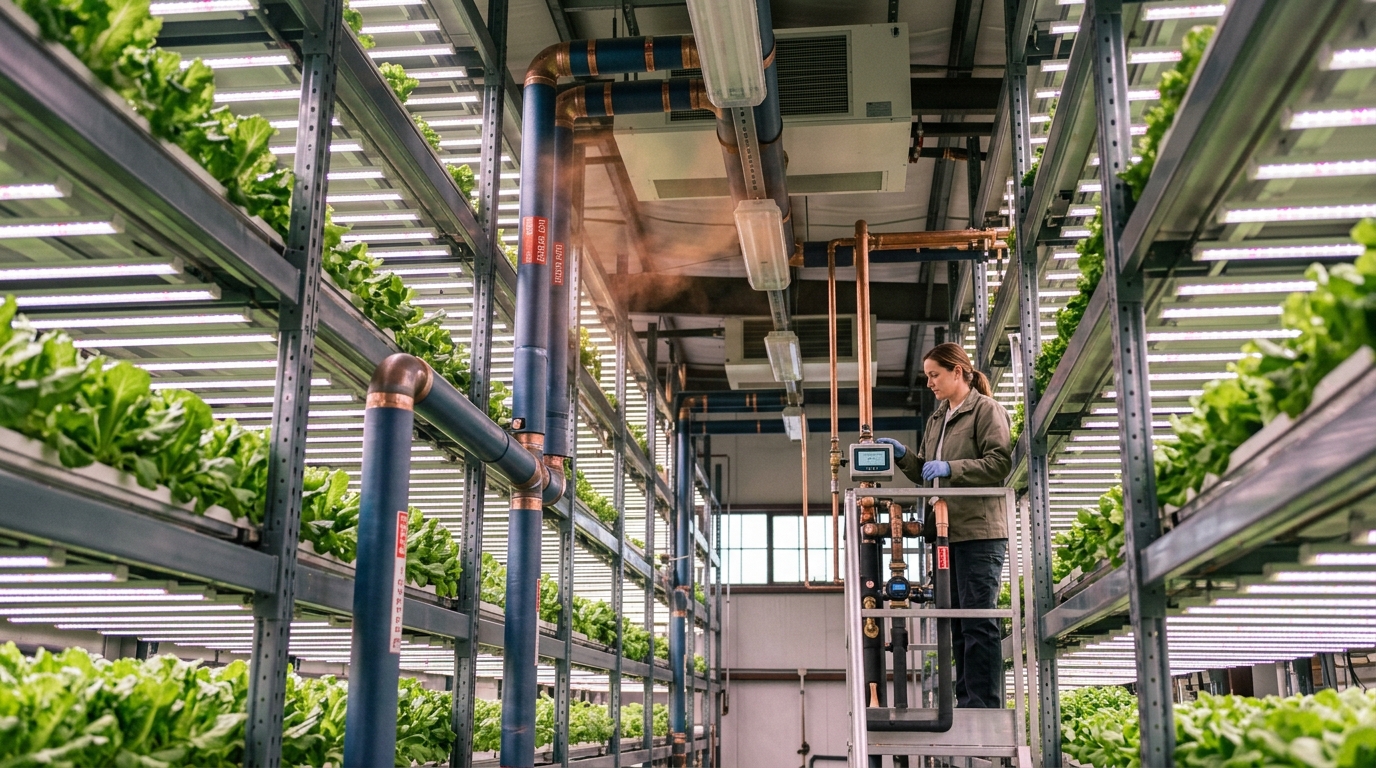
Every watt of electricity that enters a commercial vertical farm eventually becomes heat. Not most of it. All of it. The crop itself captures only a small fraction of input energy as stored plant matter. The rest radiates off LED fixtures, nutrient pumps, and HVAC compressors and has, until recently, been treated as a disposal problem.
That framing is changing fast, and the economics behind the shift are more interesting than the agritech headline writers have noticed.
The Physics Nobody Priced
Vertical farming energy use is dominated by LED lighting, which often accounts for the majority of a facility’s total electricity consumption. Of the electricity converted into light, only a small fraction ends up stored in the harvested crop; the remainder becomes heat, which can be captured and monetized as a secondary revenue stream. The useful temperature range can sit in the warm-water band suitable for greenhouse integration, aquaponics systems, and biogas digesters, and can be raised via heat pumps for district heating connections.
Liquid cooling at the LED can intercept heat before it radiates into the room, which means the facility’s own climate control system has less heat left to remove. That shows up directly as a lower electricity bill, independent of whether the captured heat is ever sold to anyone. Two savings for the price of one pipe.
What the Grid Will Actually Pay
The thermal export story runs in parallel with a second revenue channel that most operators are leaving on the table: demand response. Vertical farms can operate as flexible electricity consumers that deliberately dim lighting when grid power is scarce or expensive, and get paid for doing so. In practice, payments vary widely by program design and market, and are not reliably captured by a single national number.
Farms with battery storage and flexible lighting schedules can participate in demand response programs by curtailing load during emergencies. For a 1 MW facility, the annual dollars can be meaningful, effectively a payment for the operational flexibility that energy-optimized farms already possess.
In Northern California, PG&E continues to run demand response offerings, and CAISO’s summer reliability planning explicitly assumes demand-side resources as part of extreme-event operations. The driver is not a single 2026 incentive surge as much as an ongoing policy push to reduce load during heat-driven grid stress.
The Dutch Proof of Concept
Research has explored the theoretical potential for vertical farms to supply residual heat to local district heating networks, using a stepped approach to design energy systems that achieve thermal balance through heat and cold exchange between a vertical farm and surrounding buildings. The results are striking. Compared to a baseline scenario, the energy system with an integrated vertical farm reduces overall energy use by 15 percent, even accounting for the farm’s own electricity draw. By adopting intermittent lighting aligned with electricity price fluctuations, the farm obtained annual cost savings of 14 percent.
A Helsinki modeling study went further, factoring vertical farms directly into the capacity planning of the city’s district heating network, which supplies roughly nine-tenths of Helsinki’s heating needs.
Why the Investment Case Is Still Underpriced
The vertical farming industry has entered a new phase, defined less by hype and more by hard-won operational credibility. Market projections vary sharply by source, but many forecasts still put the global market in the tens of billions of dollars by the early 2030s, with double-digit compound annual growth implied in the more optimistic cases.
The operators who will separate themselves are not growing more efficiently than peers. They are reclassifying what the farm produces. A facility that sells lettuce and thermal capacity and grid flexibility is a fundamentally different business than one that sells lettuce and pays to cool itself. The market has not priced that distinction yet. That gap is where the opportunity sits.