
Dear Reader,
You lock your doors. You shred your mail. You watch what you post online.
But on June 18th, five federal agencies, including the Federal Reserve, proposed a rule that reaches somewhere most people never think to protect…
Your money.
Private companies now issue their own digital dollars, used for payments and transfers online.
The new rule would require those companies to identify every customer the same way a bank does.
Your name, attached to every digital dollar you buy.
Most people missed it.
They were busy celebrating the July 11th ban on the Fed’s digital dollar, which does nothing to stop the private versions.
Now you might be thinking…
“I don’t use digital dollars. Why should I care?”
Because Bank of America, Wells Fargo, Citi and Capital One are among 21 financial institutions planning a joint one, targeting launch next year.
A digital dollar backed by Visa and Mastercard went live September 30th.
PayPal’s is already in Venmo.
Zelle has announced one too.
Sooner or later, the dollars in your accounts will likely move through these systems.
And any privacy-minded person should read this twice…
Right now, the rule only covers buying digital dollars from the company.
But the agencies are considering going further.
Tracking your name every time those dollars change hands.
Person to person. Payment to payment.
Public comments closed August 21st. Now the decision is up to them.
It’s being framed as crime prevention.
It always is… isn’t it?
What’s in your safe is yours. What’s in the bank is a promise.
Digital dollars work like the bank.
A company stands behind every one, and by law that company must be able to freeze them.
But some digital assets have no company or bank behind them at all. You hold them directly, like what’s in your safe.
That’s why I recorded a free presentation on our “Digital Dollar Immunity” System.
It shows how we hold a portion of our assets outside that system.
4,500+ members are already doing this.
If you have $50k+ saved for retirement and want to protect your family from whatever comes next, watch it now:
Click Here To Reveal The “Digital Dollar Immunity” System →
To your wealth,
Tan Gera, CFA®
Decentralized Masters
P.S. The public comment window closed August 21st. The final rule is still coming.
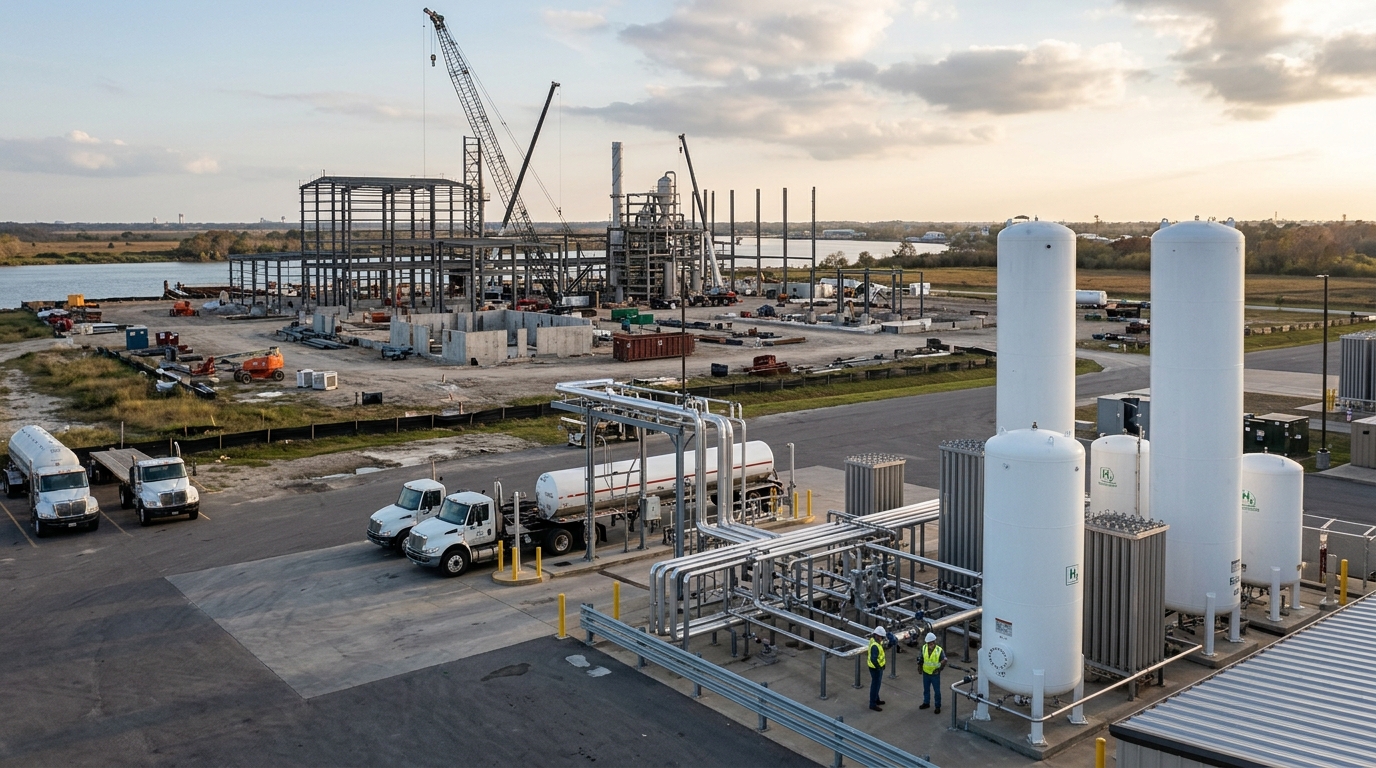
Air Products Exits Louisiana Project. The Hydrogen Bet Lives.
The headline from Air Products’ fiscal Q3 was brutal on the surface. Air Products reported a fiscal third-quarter 2026 GAAP loss of $6.47 per share, driven by approximately $2.9 billion in pre-tax project exit charges tied to its decision to not proceed with the Louisiana Clean Energy Complex and to discontinue the zero-carbon liquid hydrogen facility in Casa Grande, Arizona, along with other smaller clean energy distribution projects. Markets reacted to that number. They probably should have looked harder at what APD kept.
In the same quarter, the company reported adjusted EPS of $3.47, and management raised full-year fiscal 2026 adjusted EPS guidance to $13.39 to $13.49 in its July 30, 2026 earnings release. That is not a company in retreat. It is one reallocating toward projects with better risk profiles, and the direction points squarely at hydrogen distribution and delivery modes that scale.
Here is the structural problem APD has been navigating. Compressed gaseous hydrogen is commonly transported in tube trailers at roughly 180 to 250 bar, and hydrogen pipelines typically operate in the tens of bar, often cited in the 30 to 80 bar range. That works, but gas-phase logistics run into a density wall that shows up fast in delivered cost. Cryogenic liquid solves the density problem but introduces a different cost layer: energy-intensive liquefaction, boil-off losses, and specialized equipment. Neither path is cheap enough to make hydrogen competitive across the full heavy-industry and heavy-transport market APD is targeting.
Metal-hydride solid-state storage is the third option, and it remains one of the few approaches that can improve volumetric density while dialing down operating pressure. In selected systems, volumetric hydrogen density can reach around 150 kilograms of hydrogen per cubic meter. Operating pressures can also be materially lower than high-pressure gas storage, though real-world system pressures vary by material and design. That is not academic interest. It is industrial capital circling a genuine logistics problem.
High-entropy alloy systems, which exploit lattice distortion and tunable hydrogen adsorption sites, have shown reversible storage capacities above 2 wt% at room temperature in published research, including systems that emphasize cycling stability. The tradeoff is thermal management: releasing hydrogen from a hydride bed requires heat input, and managing that at scale is a genuine engineering constraint. Recent research continues to focus on destabilization and catalysis strategies, including magnesium-hydride composites with transition-metal and carbon-based additives, to lower practical desorption temperatures toward the low hundreds of degrees Celsius in some configurations.
For APD specifically, the strategic logic is cleaner than it looks. Air Products positions itself as the world’s leading hydrogen supplier, with long-standing infrastructure across pipeline, on-site supply, and delivered modes. The company has also emphasized hydrogen’s role in supporting decarbonization goals in heavy industry and heavy-duty transportation. A storage medium that cuts operating pressure, avoids cryogenic equipment, and survives repeated charge-discharge cycles fits that delivery infrastructure directly.
APD’s next earnings conference call is scheduled for November 5, 2026. Watch for any language around distribution technology investment. The Louisiana project exit cleared capital. The question now is where it lands, and solid-state hydrogen storage is one of the few places where the physics, the logistics economics, and Air Products’ existing supply position all point in the same direction at once.
The lesson: A large write-down draws attention, but the more useful trader’s exercise is identifying what a company kept after it cleared the deck. APD’s pivot away from mega green-hydrogen construction does not reduce its hydrogen exposure. It concentrates it on the part of the value chain where margins are most defensible.