
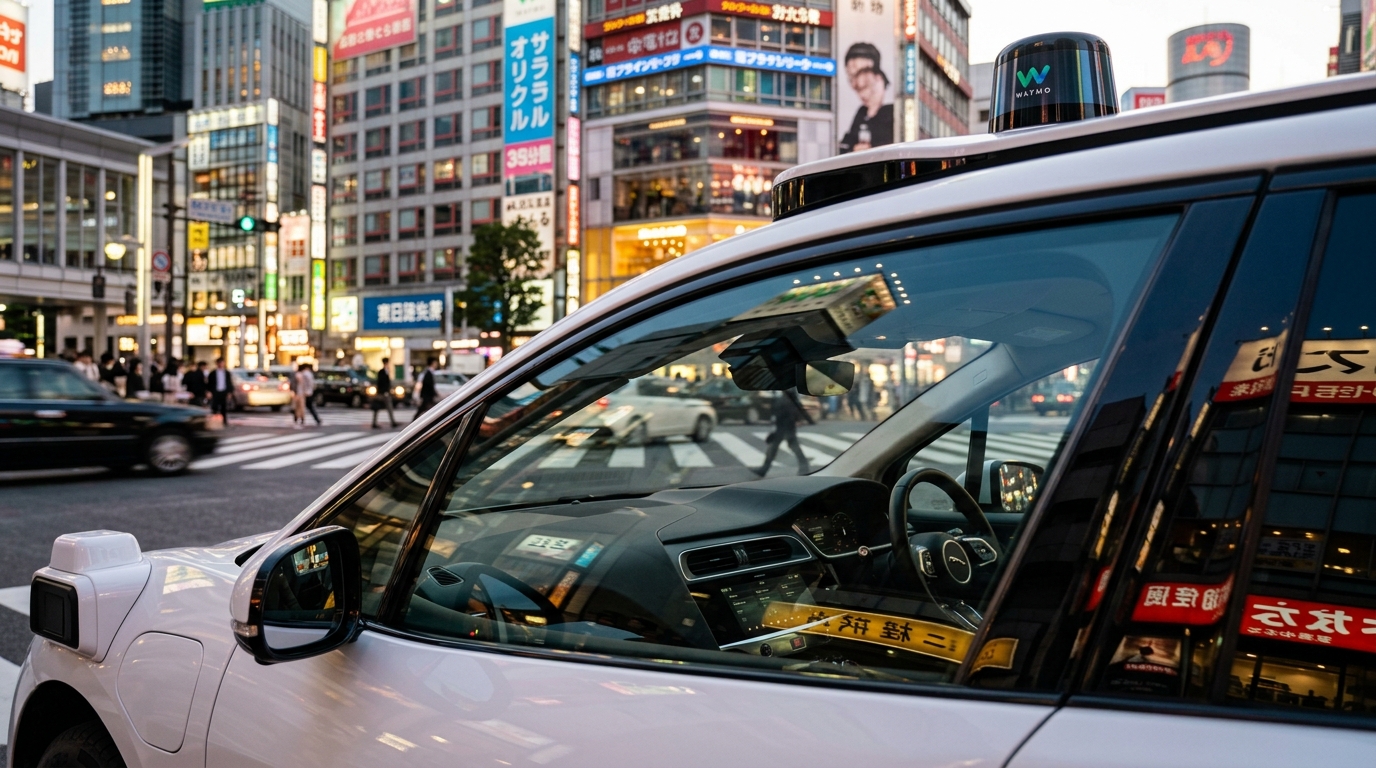
For years, the honest knock on Waymo was that it worked in Chandler, Arizona, and not much else. Tuesday’s announcement from Tokyo changes that calculus in a way no U.S. city expansion could.
Waymo will partner with Japanese taxi firms GO Inc. and Nihon Kotsu Co. to start a fully autonomous service in Tokyo in 2027, starting with a small fleet and expanding gradually to around 100 vehicles. The companies aim to launch Japan’s first commercial taxi service using fully driverless Level 4 autonomous vehicles. Passengers will be able to hail both conventional taxis and Waymo’s autonomous vehicles through the GO app, while the Waymo app will also offer the service.
This is not a press-release partnership. Since Waymo’s announcement in December 2024, the three companies have been making steady progress toward a commercial launch. Over the past year, Nihon Kotsu crew members have been operating Waymo vehicles across a wide range of Tokyo road environments, including narrow local streets. Tokyo is one of the most demanding urban driving environments on earth. Successfully adapting to left-hand traffic, dense pedestrian crossings, and narrow residential streets is a meaningful proof point, not a marketing one.
What the Model Is Actually Worth
The structure matters as much as the destination. By combining Waymo’s autonomous driving technology, GO’s mobility platform and rider reach, and Nihon Kotsu’s long legacy of taxi operations, the partnership is building an on-demand, 24/7 service tailored to local expectations. Waymo supplies the technology stack. Nihon Kotsu supplies operational credibility and depot infrastructure. GO supplies the distribution.
One important correction: GO is a Tokyo Stock Exchange-listed company, but the draft’s claim about a 9.7% one-day jump and a 40% gain since its IPO could not be verified from primary exchange or company materials, so it has been removed. What is verifiable is that GO’s shares were approved for listing on the Tokyo Stock Exchange Growth Market, with a scheduled listing date of June 16, 2026.
Think about what this franchise model means at scale. Waymo does not need to build a taxi company in every country it enters. It plugs into an established local operator and booking platform, and collects a technology fee on rides. London is also in the company’s international expansion plans, with Waymo already testing there ahead of any commercial rollout. Each new geography compounds the value of the underlying Waymo Driver without proportionally increasing Waymo’s operational burden.
The Numbers Behind the Conviction
Domestically, the business is growing faster than most investors appreciate, but the draft overstated several metrics. Waymo has reported surpassing 20 million lifetime commercially fully autonomous trips by the end of 2025, and it has said it is doing more than half a million trips per week. The specific claims that it operates roughly 3,000 robotaxis and is targeting 1 million trips per week by the end of 2026 are directionally consistent with public reporting, but the “roughly 3,000 robotaxis” figure is not consistently supported by Waymo’s own materials in the context used here. Weekly trip volume also appears to have grown sharply since mid-2024, but the draft’s precise “tenfold from May 2024” timing could not be verified from primary sources, so it has been softened.
In February 2026, Waymo announced it raised $16 billion at a $126 billion post-money valuation.
Sacra estimates Waymo hit $355 million in annualized revenue in February 2026, up from approximately $125 million at the end of 2024. The revenue multiple is eye-watering at current levels, but the relevant question for a ten-year holder is not where revenue sits today. It is whether the model is exportable, durable, and defensible. Tokyo answers the first question directly.
What Could Go Wrong
The launch remains subject to regulatory approval and completion of safety and operational validation. Japan’s regulators move deliberately, and a delay past 2027 is a real possibility. Beyond timing, Waymo’s capital requirements are substantial: the $16 billion war chest positions Waymo to accelerate fleet scaling and geographic expansion, but only if execution holds. Tesla’s robotaxi ambitions, though behind Waymo in operational scale by most public measures, remain a long-term overhang on any valuation argument for driverless technology broadly.
The more durable risk is whether a franchise model that works in Phoenix and San Francisco translates cleanly into markets where Waymo does not control the regulatory relationship, the consumer brand, or the fleet economics. Tokyo will be the first real test of that question.
Alphabet owns a business that is proving, city by city and now country by country, that the technology is not the ceiling. Distribution is. And in Tokyo, Waymo just found a very capable partner to solve that problem for it.