
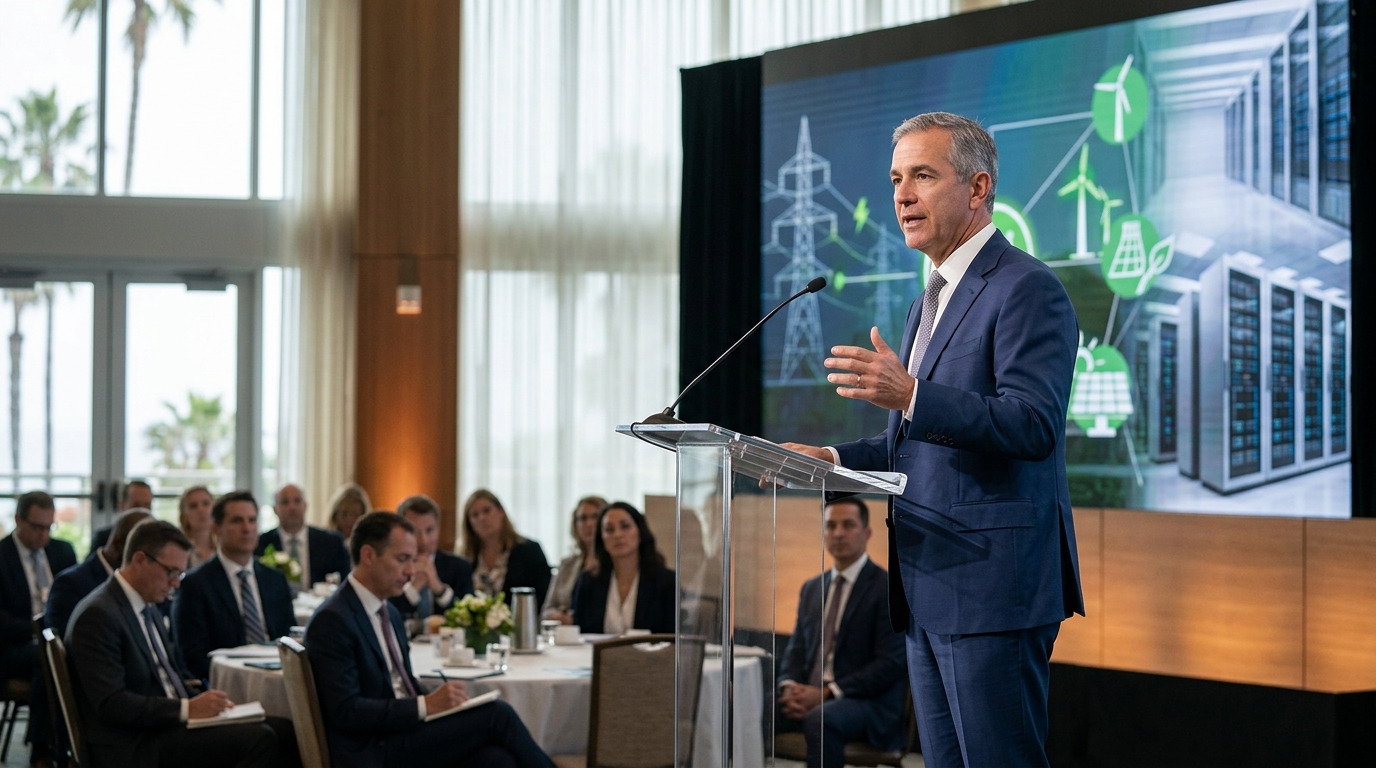
The electrification trade has had a difficult summer, and today’s Morgan Stanley Laguna Conference in California is effectively its first public reckoning on the record. Eaton CEO Paulo Ruiz speaks at 1:50 p.m. Pacific time in a fireside chat covering the company’s growth strategy, portfolio transformation, and demand across data centers, utilities, and aerospace. GE Vernova’s Scott Strazik is also on the agenda. So is Boeing’s Kelly Ortberg. But it is Ruiz who carries the most pointed assignment: persuade a skeptical investor audience that Eaton’s premium valuation is earned, not borrowed from a load-growth forecast that may never fully materialize.
What the Transformation Actually Looks Like
The portfolio story Ruiz will tell is not theoretical. In January, Eaton announced its intention to separate its Mobility business from the rest of Eaton via a spin-off into an independent, publicly traded company, with Ruiz framing the move as sharpening focus on the core Electrical and Aerospace businesses aligned to electrification, digitalization, AI, and defense demand. That separation was subsequently structured as a Reverse Morris Trust with Dana Incorporated. Eaton will separate and combine its Mobility Group with Dana in a transaction creating a combined company valued at over $10 billion. The deal is expected to close in the first quarter of 2027 and deliver an approximately $1.1 billion cash distribution to Eaton, subject to customary adjustments.
This follows a decade-long pattern. The Mobility separation builds on earlier divestitures of Lighting in 2020 and Hydraulics in 2021. What remains is a focused portfolio of electrical and aerospace assets, both exposed to the capital-spending cycle that has driven Eaton’s stock sharply higher over the past two years.
The financial results through mid-2026 are difficult to argue with. Eaton’s second quarter 2026 results set records across key metrics, with adjusted earnings of $3.15 per share and segment margins of 23.1%. Total sales were $8.5 billion, up 21% year over year, including 14% organic growth. Management said data center orders increased approximately 85% and data center revenue grew approximately 65% in the second quarter. Management then raised full-year adjusted EPS guidance to $13.40 to $13.60.
The Rate Environment Complicates the Multiple
Here is where the Laguna chat gets harder. The effective federal funds rate sits around 3.63%. Beyond that, the forward path is best treated as conditional, not a schedule. That is a meaningfully different environment than the one that justified 40-times earnings multiples for industrial compounders a year ago.
GE Vernova illustrates the exposure. The stock has been volatile since its summer highs, and it has shown a tendency to move on sentiment around the gas-turbine cycle and the broader AI-infrastructure theme. The read-through to Eaton is not identical, because Eaton’s product diversity is real and its backlog is broad. But the group trades as a bloc when sentiment shifts, and sentiment has shifted.
What the Bull Case Actually Requires
To own Eaton, investors need to believe in long-term demand for electrification and data center power and cooling, but the main current risk is heavy dependence on U.S. AI data center and mega-project spending, at a time when the share price already reflects a premium valuation. Eaton has highlighted unusually strong data center momentum in recent quarters, but rates of growth like those are, by definition, hard to sustain at a steady state.
Strategic partnerships with Nvidia and Siemens Energy, alongside acquisitions including Fibrebond and Resilient Power Systems, are positioning Eaton as a go-to provider for next-generation high-density and AI-centric infrastructure. The company has also pointed to more than $1 billion of capacity expansion investment tied to a large slate of projects across Electrical Americas. Those are the kinds of capital commitments that create real switching costs and real execution risk simultaneously.
The Verdict
The portfolio transformation Ruiz has engineered is credible and structurally sound. Eaton emerging from the Mobility separation will be a cleaner, higher-margin business aligned to durable spending cycles in power infrastructure and aerospace. The question today’s Laguna audience will press is whether the execution cadence can hold at a funds rate that remains meaningfully higher than the last cycle’s lows, against load-growth assumptions that remain, at their core, a forecast. Eaton’s moat is real. The price it commands for that moat deserves scrutiny. That is exactly the right conversation to be having on September 16, 2026.