
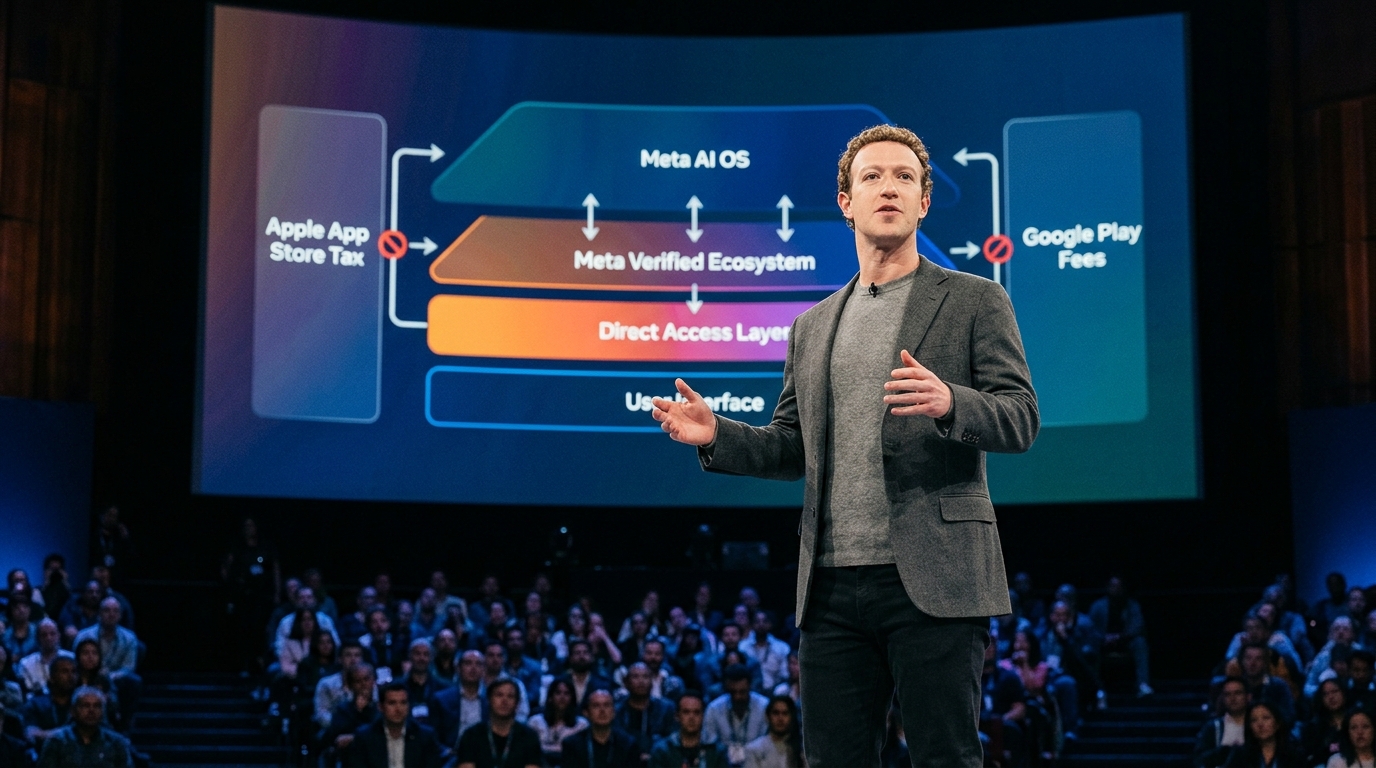
For a decade, Facebook paid Apple and Google billions in app-store fees and ad-auction dependency to reach its own users. Every time someone opened Instagram on an iPhone, Apple collected its toll. Every search that sent traffic to Meta properties ran through an ecosystem Google controlled. Zuckerberg has spent a considerable portion of his career being reminded that this arrangement was permanent.
The product announcements from Meta Connect on Wednesday night suggest he no longer believes that.
Meta’s Project Phoenix is now the Meta VR Glasses, a compute puck-tethered device priced at $1,300 and slated to go on sale in spring 2027. It weighs 100 grams, uses 2.4K micro-OLED displays, and is powered by Qualcomm’s Snapdragon Reality Elite chipset. Separately, Ray-Ban Meta Audio, Meta’s first camera-free glasses, start at $349 with pre-orders open and shipping October 13. They weigh 43 grams and run for 12 hours on a single charge. The third-generation Ray-Ban Meta with camera is on sale now from $449. And then there is the Muse Charm: a pendant-style device briefly shown at the end of the keynote that houses your personal Muse Agent with a small display, speakers, mics, and a fingerprint sensor.
The product range matters less than what it signals. Meta is not trying to win the VR headset market. It is trying to construct a consumer computing layer that bypasses smartphones entirely.
The investment logic is straightforward. Zuckerberg told investors on the Q4 2025 earnings call that Reality Labs is directing most of its investment toward glasses and wearables going forward. Reality Labs lost about $4.0 billion in Q1 2026 and $4.62 billion in Q2, pushing cumulative operating losses since late 2020 to roughly $88 billion. That is not an accident. It is a deliberate capital allocation decision: spend heavily now to own a distribution channel that Apple and Google cannot extract rent from later.
The EssilorLuxottica partnership is central to this. Frames from Ray-Ban carry social permission that no tech company has manufactured from scratch. Meta’s EssilorLuxottica partnership and years of consumer conditioning have produced a dominant share of global smart glasses shipments, with Xiaomi a distant second. Smart glasses shipments more than doubled in the second half of 2025, and Meta says it is expanding to more than 100 different glasses options across Ray-Ban, Oakley, and Meta Glasses by end of year. The width of the product line, from a $249 Meta Adventurer to a $1,300 VR headset, is a deliberate attempt to occupy every price point before Apple arrives.
Because Apple is coming. Bloomberg’s Mark Gurman has reported Apple is targeting a late 2027 release for its first smart glasses, and the device could be introduced at WWDC 2027. Google unveiled Android XR-powered AI glasses at Google I/O 2026, deepening partnerships with Samsung, Warby Parker, and Gentle Monster. Counterpoint Research has described the smart glasses market as shaping up into a multi-ecosystem race led by Meta, the Android XR ecosystem, and Apple over 2026 and 2027.
The risks are real. Qualcomm is raising prices on Snapdragon chips starting September 1, with reporting indicating the increase could be by double-digit percentages, which is why an internal Meta target of landing under $1,000 became $1,300. Reality Labs revenue remains thin: the division generated $402 million and $431 million in Q1 and Q2 2026 respectively against losses more than ten times larger. The Muse Charm was shown without a price or shipping date. Execution on hardware at this scale is hard.
But the strategic logic is sound. Meta is not building gadgets. It is building a walled garden on your face, one that collects the attention, the data, and the commerce relationship before a smartphone ever enters the picture. Every Ray-Ban sold is a customer Apple and Google now have to negotiate with Meta to reach. That is what roughly $88 billion in cumulative losses has been purchasing. Whether the price was right is what the next five years will determine.