
Below is an important message from one of our highly valued sponsors. Please read it carefully as they have some special information to share with you.
Dear Reader,
Jeff Bezos is terrified.
He will be down on his knees, hands out, begging Elon for mercy.
Because Elon is about to do something that will:
Cut Amazon out of the AI race ENTIRELY…
Completely DESTROY Blue Origin…
And take control of the potential $25 TRILLION DOLLAR PER YEAR AI INDUSTRY
And in his wake, potentially create 1,806,000 NEW millionaires over the coming years…
Starting December 8th.
And this is your chance to be one of them.
Elon Musk is currently quietly planning the biggest project of his entire career.
And a single FCC filing proves it, click here to see why.
This is bigger than Tesla, SpaceX, and X combined.
And I believe it will not only cement Elon as the winner of the AI race…
It will allow Elon to control the entire industry.
Something of this magnitude has never happened in the history of the human race.
And it’s happening FAST.
According to my timeline, you must act by December 8th.
I explain everything right here.
>>>This is your free Millionaire Maker Masterclass… and it starts right now.
Sincerely,
James Altucher
P.S. I am giving away a gift worth $1,000 to the first 1,000 people who watch and take action on my Masterclass offer today. No purchase necessary. ZERO credit card required. Just click here to watch my free video, and I’ll show you how to claim yours.
AMD Rallied While Nvidia Lagged. The Market Is Picking a Winner in Agentic AI.
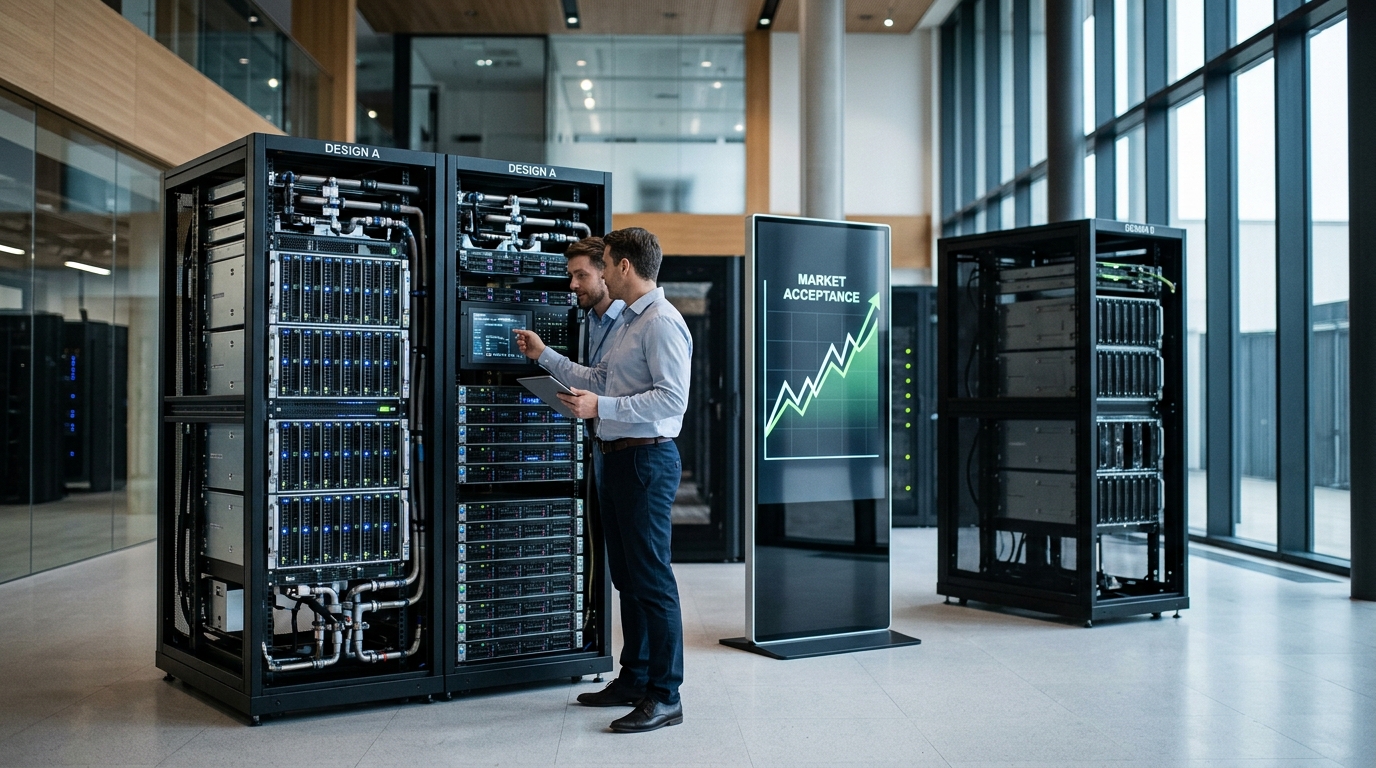
Two rack-scale AI blueprints arrived in the same week. One came from a company that already owns the market. The other came from the challenger trying to redefine it. The stock market, so far, is tilting toward the challenger.
What Happened
AMD unveiled Helion, an open rack-scale reference design for agentic AI infrastructure, on October 12, 2026, alongside the OCP Global Summit in San Jose, California. Two primary configurations are on offer: a CPU-only rack that can scale to up to 32,768 cores on 6th Gen AMD EPYC processors, and an all-in-one rack that combines EPYC CPU nodes with AMD Instinct MI350P GPU nodes and general-purpose compute. Helion also includes an integrated model-call router designed to steer agent requests across frontier and open-source models.
AMD CEO Lisa Su identified OpenAI, Meta, Microsoft, Oracle and Anthropic among the leading customers receiving initial systems. That is a list that matters. None of those customers has publicly said it has dropped Nvidia as a supplier. They are diversifying compute sourcing, not necessarily switching allegiances, and that distinction is exactly what traders should be pricing.
The timing was deliberate. Helion puts AMD in direct competition with Nvidia’s Vera CPU rack design, which Nvidia has promoted as part of its Vera Rubin platform and has also positioned for agentic AI workloads. Two competing open-rack visions, one week, one press cycle.
Why the Price Action Diverged
AMD shares rose 1.9% on Tuesday, trading as high as $606.20 and closing at $605.53. The gap is not enormous, but the direction is informative: AMD moved more aggressively on a week when both companies had open-rack headlines.
AMD’s stock is up sharply over the past year relative to Nvidia. The market is not just reacting to Helion. It is confirming a thesis that has been building all year. The shift reflects Wall Street revaluing AMD as AI evolves from GPU-centric training to inference and agentic workflows that can pull more of the system bill-of-materials into CPUs, networking, and orchestration.
There is a credible counter-argument. Nvidia says its Vera Rubin platform is ramping into full production. AMD is weakest in proof-points. Nvidia reached the market first, has named production timelines for Vera Rubin-based systems, and has published agent-focused performance claims. Being second with better specs on paper does not always translate into orders.
How Professionals Might View It
Experienced traders are watching the relative strength between AMD and Nvidia, not the absolute level of either. When AMD runs harder on the same sector catalyst, it signals that incremental dollars are rotating into the challenger. That rotation can persist for months or reverse in a single earnings cycle.
The valuation spread complicates the read. Nvidia has been described by multiple market data providers as trading in the mid-20s on forward earnings, while AMD has been closer to around 40x. A stock that has surged that much in one year needs the orders to materialize on schedule, not just be announced. AMD has said Helion rack configurations are planned to be available in November 2026, which means upcoming results and guidance will be the first real test of whether the partnership list translates into recognized revenue.
AMD has scheduled fiscal third-quarter 2026 results for November 3, 2026. That report arrives before a Helion volume ramp is likely to be visible in the numbers, so the reaction will hinge almost entirely on forward guidance. A disciplined trader sizes positions accordingly rather than chasing the post-announcement lift.
What Comes Next
Watch Supermicro and Vertiv for confirmation signals. Both are named Helion ecosystem partners. If their order books expand ahead of the November availability window, that is independent evidence that customers are committing capital, not just press quotes. Infrastructure suppliers often tell the demand story before the chip company’s own financials do.
Infrastructure partners often move before the chip names do. Vertiv’s order book and margin expansion have already shown how rack-level AI demand flows through the ecosystem suppliers before it appears in semiconductor revenue.
Also watch how Nvidia responds. The central question is whether customers prefer AMD’s modularity or Nvidia’s integration when agent deployments move into production. That answer will not arrive in one week of price action.
The Trader’s Lesson
Relative strength is a signal, not a verdict. AMD outperforming Nvidia after Helion’s launch tells you where near-term sentiment sits. It does not tell you where the actual infrastructure orders land six months from now. The traders who will profit most are those who use the relative strength as an entry criterion while keeping position size disciplined enough to survive the November earnings report without being forced out. Announcements move stocks. Revenue moves trends.