October 20, 2026
Bonus Content: Verizon Is Selling Dark Fiber to Google
|
A SPECIAL INVESTOR STORY · FALL 2026 Are Pesticides An essential global industry is facing a familiar collision of public pressure, regulation and technological change. |
For decades, tobacco looked permanent.
It was deeply embedded in daily life, supported by powerful companies and protected by enormous demand. Then the evidence, lawsuits, regulation and public sentiment began to converge.
The industry did not disappear overnight. But capital, consumer behavior and corporate strategy began to move.
|
Chemical pest control is essential to agriculture, public health, homes and businesses. Yet concern around conventional formulations continues to grow – from exposure and residues to resistance and environmental impact.
That creates a paradox investors should not ignore:
|
The world could quit smoking. |
If pressure forces the category to evolve, demand does not vanish. It may migrate toward products designed to meet changing expectations.
|
One small company has spent years building botanical pest-control products for professional and consumer use. Its name is Med-X, Inc. The company is currently private and has reserved MXRX for possible use following a successful future Nasdaq listing. Its Nature-Cide portfolio sits directly inside this developing conversation.
This is not a prediction that pesticides will become tobacco. It is a question about what happens when an indispensable industry can no longer remain exactly as it was.
|
Discover the evidence, the market transition and the company positioned inside it.
Verizon Is Selling Dark Fiber to Google
There is a power shift happening beneath the world’s oceans, and most equity investors are reading it backwards.
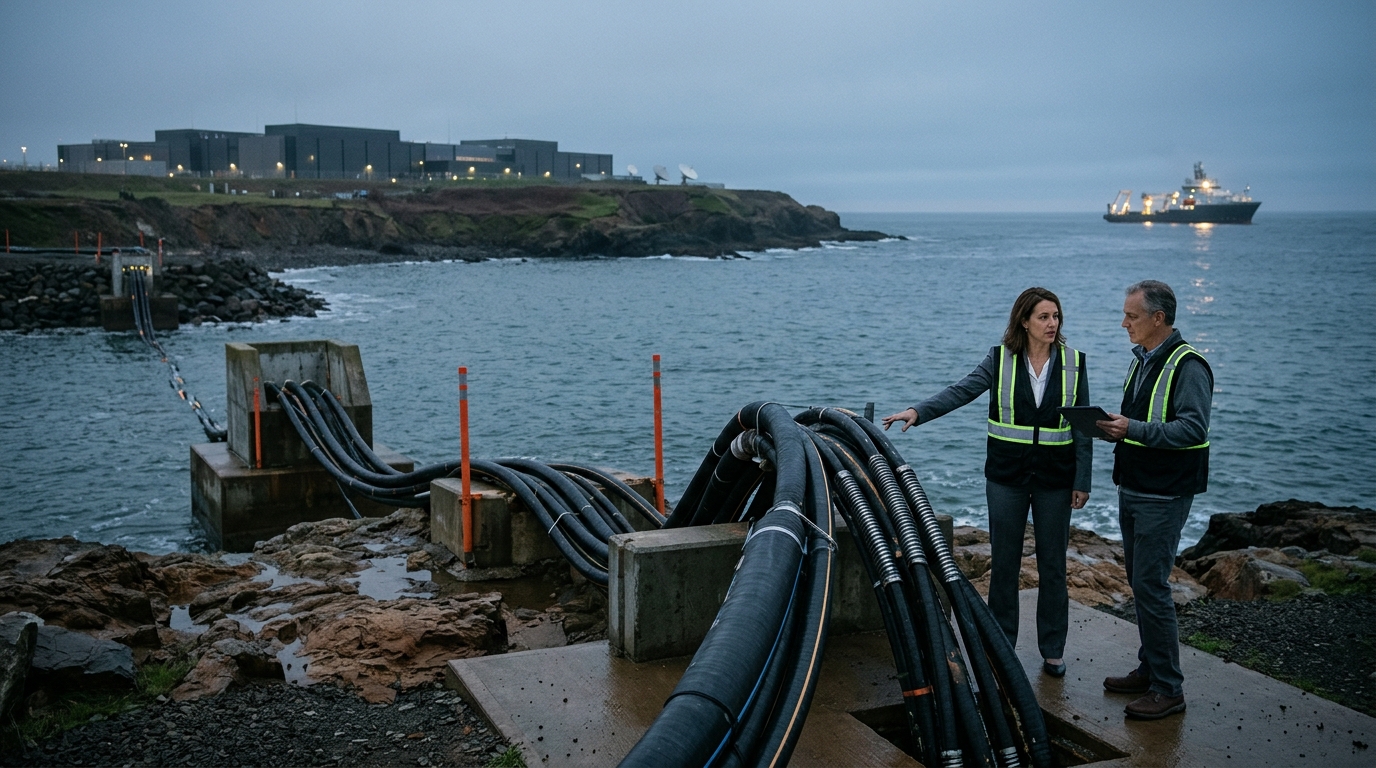
More than 99% of international data traffic travels through hundreds of commercial submarine fiber-optic cables spanning roughly 1.4 million kilometers beneath the oceans, and hyperscalers, Google, Meta, Microsoft, and Amazon, now command about 71% of global subsea fiber capacity on those systems. That figure was negligible in 2010. The traditional telecom consortium model, where carriers pooled capital to build and share cables, has been effectively displaced.
Google, Meta, Microsoft, and Amazon now collectively control around 90% of capacity on the transatlantic route. Meta announced Project Waterworth, a solo commitment spanning more than 50,000 kilometers across five continents with landing points in the U.S., India, Brazil, and South Africa, which Meta has described as the world’s longest subsea cable project once complete. Meta also announced Petal, a transatlantic cable connecting France and the United States that Meta says will deliver 1 petabit per second of capacity when it enters service in 2029, which Meta has described as the first subsea cable to deliver petabit capacity at transoceanic distances.
Legacy telecoms did not build those cables. So where does that leave Verizon?
Closer to the money than most realize. During Verizon’s Q2 2026 earnings call, CEO Dan Schulman disclosed an agreement with Google worth “well in excess of a billion dollars” for Google to use Verizon’s dark fiber to connect data centers. Dark fiber is installed fiber-optic infrastructure that is not yet lit as a service, meaning the customer can operate it with its own networking gear, giving a hyperscaler dedicated capacity and control over network design rather than a managed telecom service. That distinction is what makes this arrangement sticky: Google gets control of the optical layer; Verizon collects long-duration contracted revenue without carrying any of the traffic risk.
Schulman added, “We have other deals that we expect to announce by year-end that, taken together, are expected to be worth multiple billions of dollars in revenue over the next several years.” To underwrite that pipeline, Verizon committed to buying more than 80 million miles of high-density optical fiber from Corning under a multi-billion dollar agreement running 2027 to 2032, covering both the fiber-to-the-home push and the dark fiber Verizon plans to sell into AI infrastructure.
The fiber bottleneck is not the only physical constraint shaping how hyperscalers spend. Hyperscaler capital expenditure is running into power grid limits that cannot be solved by writing larger checks.
The trading lesson here is structural, not cyclical. The transition from a model dominated by telecommunications consortia to one increasingly led by private capital from content and cloud providers has fundamentally reshaped supply dynamics and investment rationale. Carriers that try to out-invest hyperscalers in subsea ownership will lose. Carriers that position as indispensable intermediaries, leasing physical fiber assets hyperscalers need immediately and cannot build fast enough, earn a different outcome entirely.
Google’s infrastructure constraints extend well beyond the ocean floor. Google’s internal compute allocation problem has already forced trade-offs between its own AI research and external cloud revenue commitments, a pressure that makes ground-level fiber access more urgent, not less.
Hyperscaler demand is running into a genuine supply constraint. The specialist cable-laying fleet is small, and the manufacturing base is concentrated among a handful of suppliers, chiefly SubCom, Alcatel Submarine Networks, NEC, and HMN Technologies. That bottleneck makes every mile of existing, deployable fiber more valuable, not less.
Verizon’s real bet is not that it can compete with Google’s subsea ambitions. It is that Google cannot move fast enough without Verizon’s ground-level glass.