
October 20, 2026
Bonus Content: Chip Stocks Bounced. Asia Didn’t Buy It.
Most traders have never noticed the weird market anomaly that happens at 9:35 AM every morning.
They’re too busy with lagging indicators trying to predict the next move… when the market makers have already set the tone for the trading day.
It’s this weird anomaly that points us to the market maker’s key levels above and below.
And by playing the move within that range…
Regular folks like you have been able to reach for $100 or more (on a $1K stake) over 600 times in the last 2 years.
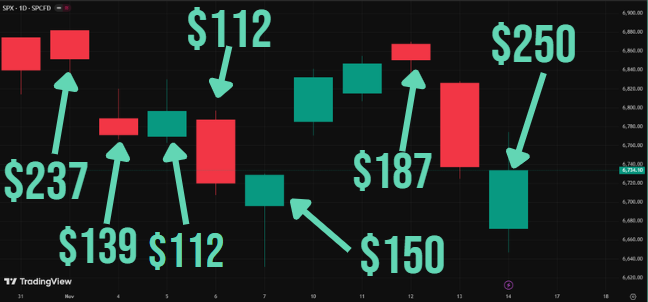
We’ve seen this straightforward approach play out whether the market broke out… broke down… or stayed choppy.
Granted, I can’t make trading guarantees here.
But I’ve opened up the data behind those trades, as well as how you can get in on the very next morning opportunity.
You’ll find the full details right here.
See you in the market.
Chris Pulver
Chip Stocks Bounced. Asia Didn’t Buy It.
Chip Stocks Bounced. Asia Didn’t Buy It.
The semiconductor index snapped an eight-day losing streak on Monday, but the move faded intraday and global markets refused to follow. That tells you something important about what kind of bounce this was.
The Philadelphia Semiconductor Index ended its longest losing streak since October 2008 on Monday. That sounds like a bottom. It probably isn’t one.
The index closed lower for eight consecutive sessions, from October 7 through October 16, falling about 15.7% and ending Friday well below its June 22 record close. The SOX rose about 1.6% on Monday to end that eight-session skid, though it was up as much as about 3.7% earlier in the session.
That fade matters. When genuine capitulation ends a rout, buyers typically sustain the move. When positioning mechanics snap a streak, the rally often runs out of fuel by the close.
What Happened
U.S. stocks closed mixed on October 19, with the Nasdaq up about 1.1%, the S&P 500 up about 0.4%, and the Dow down slightly.
Memory and storage-linked chip stocks led the gains, with Western Digital up about 6.1%, SanDisk up about 5.5%, and SK Hynix ADRs up about 4.7%.
Amazon climbed nearly 5% after Morgan Stanley raised its price target to $350 and named it a top pick, citing stronger AWS expectations and AI-related catalysts.
The session had the ingredients of a real reversal: a technical level held, oversold readings unwound, and a catalyst arrived in the form of the Morgan Stanley call. But one session’s breadth told a different story. The buying was concentrated in chip and AI computing-related names rather than a broad advance, indicating that capital was reallocated within the AI theme rather than returning to risk assets more generally.
Why Asia Refused to Follow
South Korean and Japanese stocks fell on Tuesday despite an overnight rebound in U.S. technology shares, as investors remained reluctant to rebuild exposure to Asia’s biggest artificial intelligence trades ahead of a heavy earnings week.
That is not the behavior of a market convinced the worst is over. The dominant thread is fatigue in the AI complex, with chip-heavy Korean and Japanese benchmarks underperforming even as U.S. tech bounced.
The Korean market’s reluctance has a specific precedent worth understanding. Samsung and SK Hynix have already shown how fast AI-driven selling in Seoul can outpace the U.S. move that triggered it.
Europe added to the skepticism. Major indexes in the region fell on Monday, with defensives holding up better than cyclicals. Health care and consumer staples showed relative resilience, the configuration that often appears during growth-stock unwinds, not recoveries.
How Professionals Should Read This
HSBC chief multi-asset strategist Max Kettner described it plainly: “It is an incredibly technically-driven market,” and he sees no fundamental catalyst, outside of earnings, capable of calming nerves around AI. That distinction is worth building into your process right now.
A technically driven bounce means oversold momentum indicators reset, short-sellers cover to reduce risk, and the move can be sharp without reflecting any change in the underlying concern. The sellers who drove a roughly 15.7% drawdown over eight sessions have not been proven wrong. They have simply paused. Professionals treat that differently from a fundamental re-rating, where buyers step in because something about the earnings or demand picture actually changed.
The intraday fade from a roughly 3.7% gain to a roughly 1.6% close is the quantified version of that skepticism. It means sellers returned before the close.
What Settles It
The next two weeks are where technically driven gives way to fundamentally driven, or doesn’t. Nvidia CEO Jensen Huang delivers his GTC Berlin keynote on October 21 at the Tempodrom in Berlin, giving the market its first major post-selloff read on enterprise AI demand from the company at the center of the trade. Amazon’s third-quarter results arrive on October 29, where any sign of accelerating cloud growth would support the bull case. Intel also reports later that week.
Whether the semiconductor sector can extend its recovery will depend on guidance from large technology companies. Until that guidance arrives, the bounce deserves respect as a tradable move but not yet as confirmation that the eight-day decline resolved into a base.
The earnings catalyst the article is waiting on has a structural backdrop that shapes how guidance will be read. Hyperscaler capital expenditure has become the market mechanism that turns AI revenue beats into stock selloffs.
The Trader’s Lesson
The length of a losing streak tells you about exhaustion, not about value. Eight consecutive down sessions is a signal that positioning became extreme, not that prices found fair value. The discipline is to distinguish between the two before sizing a position. Buying because a streak ended is buying a technical condition. Buying because earnings guidance confirms demand is buying a fundamental shift. Right now, only one of those has happened.