
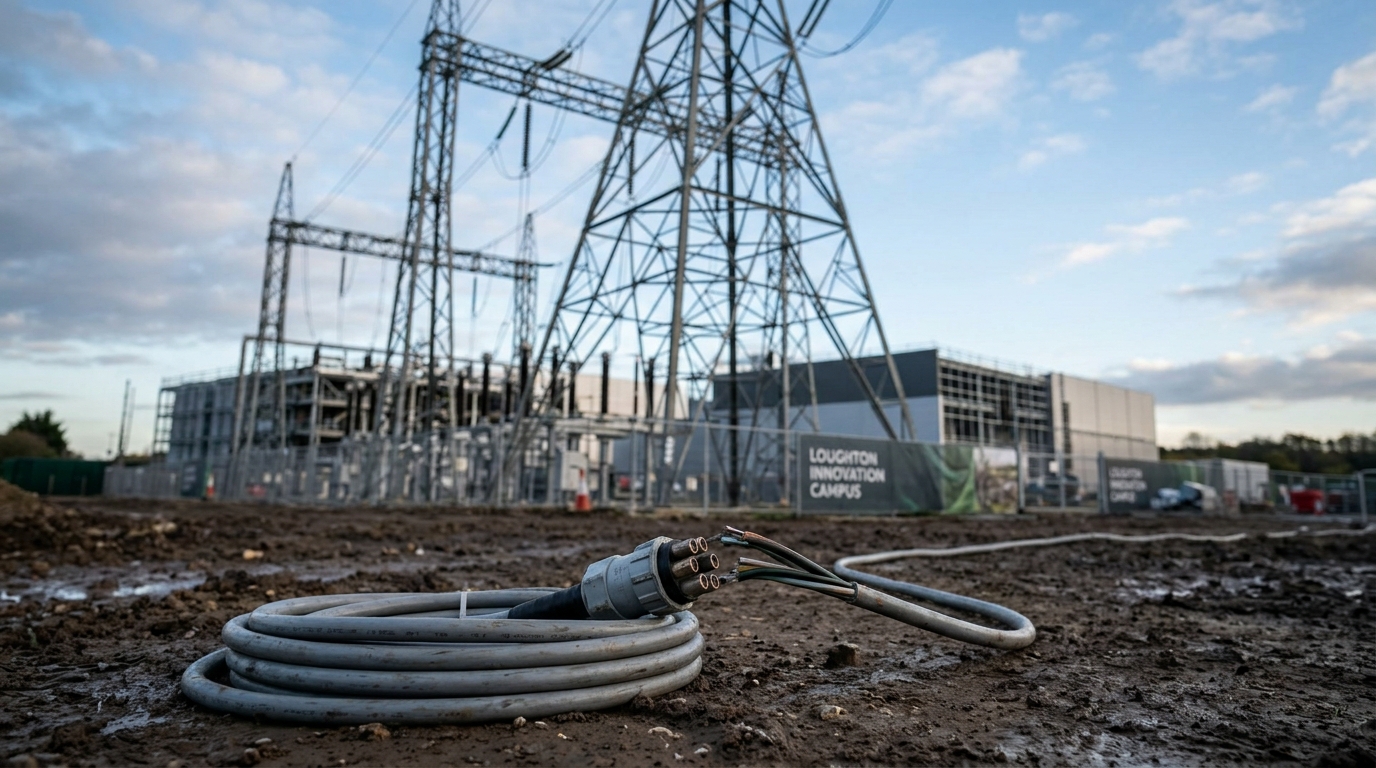
The question portfolio managers were already asking quietly is now loud. Microsoft has terminated its anchor tenant agreement at Nscale’s flagship planned data center in Loughton, Essex, after UK Power Networks informed the company that grid capacity for the 90-megawatt site would not be available until the 2030s. Microsoft was the facility’s only publicly announced customer. The Loughton deal had been contending with delays due to power constraints. Now the anchor is gone, and the question institutional investors are sitting with is not whether Nscale can replace it. The question is how many other data-centre developers are carrying the same risk on their balance sheets right now.
What This Does to the IPO
Nscale, which has filed publicly for a New York Stock Exchange listing under the ticker NSCL, has been pitching a valuation around $35 billion and has said it may raise as much as $3 billion in the offering. Microsoft had signed statements of work that provide for payments to Nscale of up to approximately $43.8 billion through December 2033, and Anthropic has agreements that provide for aggregate payments of up to approximately $44.6 billion, but only $2.6 billion of that contracted value is currently live, and most of the rest depends on data centers, power plants, and GPUs that have not been built or fully financed yet. The Loughton exit does not cancel the Microsoft relationship outright. The two companies continue to work together on other data centre projects, including in Norway and Portugal. But the S-1 math gets harder when the anchor tenant walks from your flagship site months before your road show.
Nscale’s flagship site in Norway is also six months behind schedule, with only 6.4 megawatts of the intended 30-megawatt data center up and running. Nscale currently has about 55 MW active in Europe against a much larger pipeline of projects. The gap between contracted value and live capacity was already the central investor concern before this weekend. It just widened.
The Bull Case and Where It Breaks
Bulls on the neocloud sector point to the fact that AI compute demand continues to outstrip supply. The argument is that any developer who can actually deliver electrons alongside GPUs will be rewarded handsomely.
The bear case, which the Loughton exit makes harder to dismiss, is that the industry has been valuing signed letters of intent as though they were revenue. They are not. Grid operators told Nscale that a connection initially expected by the end of 2025 will not be available until the 2030s. That gap, between a hyperscaler’s signature and a functioning grid connection, is where development economics fall apart. Microsoft did not wait. A big hyperscaler rarely does.
What Investors Are Missing
The debate about AI infrastructure has centred almost entirely on GPU supply and capital expenditure capacity. Microsoft executives have repeatedly framed physical build constraints, especially space and power, as key limiting factors for bringing capacity online. That framing should reorder how institutional investors evaluate every data-centre developer in their portfolio.
The overlooked implication is a valuation bifurcation that has not yet fully happened. Developers with confirmed, near-term grid connections deserve a materially different multiple than developers with hyperscaler commitments and a power application in a queue. Right now, many are priced as though the queue is equivalent to the connection. Texas has paused parts of its large-load approval process while it audits proposed projects, and New York put in place a temporary statewide moratorium on permits for large data centers while it develops higher standards. The UK’s Essex delay is not an isolated planning mishap. It is one node in a system-wide constraint.
Stocks to Watch
Microsoft (MSFT) walks away from Loughton but has not retreated from AI infrastructure. The company’s strategy of securing dedicated power, including a 20-year power purchase agreement with Constellation Energy tied to the restart of Three Mile Island Unit 1, is precisely why it can afford to exit sites where power is not coming for years.
Nscale (NSCL) faces the harder recalibration. Losing Microsoft as anchor tenant could complicate expansion plans and increase investor scrutiny ahead of the listing, though Nscale says it remains committed to developing the Loughton site and is exploring alternative power sources. The IPO timeline now depends on whether public investors accept a $35 billion valuation for a company whose two largest contracted relationships account for roughly 85% of contracted value and whose flagship UK site has no grid connection until the 2030s.
CoreWeave (CRWV) is the most direct read-across. The specific claim that CoreWeave added more than $25 billion of net new customer commitments between June 30 and August 11, and that its total contracted power rose to approximately 4.2 gigawatts in that same window, is not supported by the company’s publicly available disclosures I could verify. CoreWeave has previously reported adding more than $25 billion of revenue backlog in a single quarter, and it has also reported contracted power in the multi-gigawatt range at different points. The critical distinction is that investors are increasingly treating power certainty, not just customer paper, as the new valuation filter.
Nvidia (NVDA) sits one layer removed but is not unaffected. The specific claim that the Loughton site was set to house around 23,000 Nvidia GB300 GPUs for Microsoft Azure services is not supported by a primary-source disclosure I could verify. Those chips, wherever they land, still need a powered hall. Every project delayed by a grid queue is a cluster of Nvidia GPUs whose deployment slides. The chips are not the bottleneck. That is worth remembering when growth estimates for the data-centre buildout are being stress-tested.