
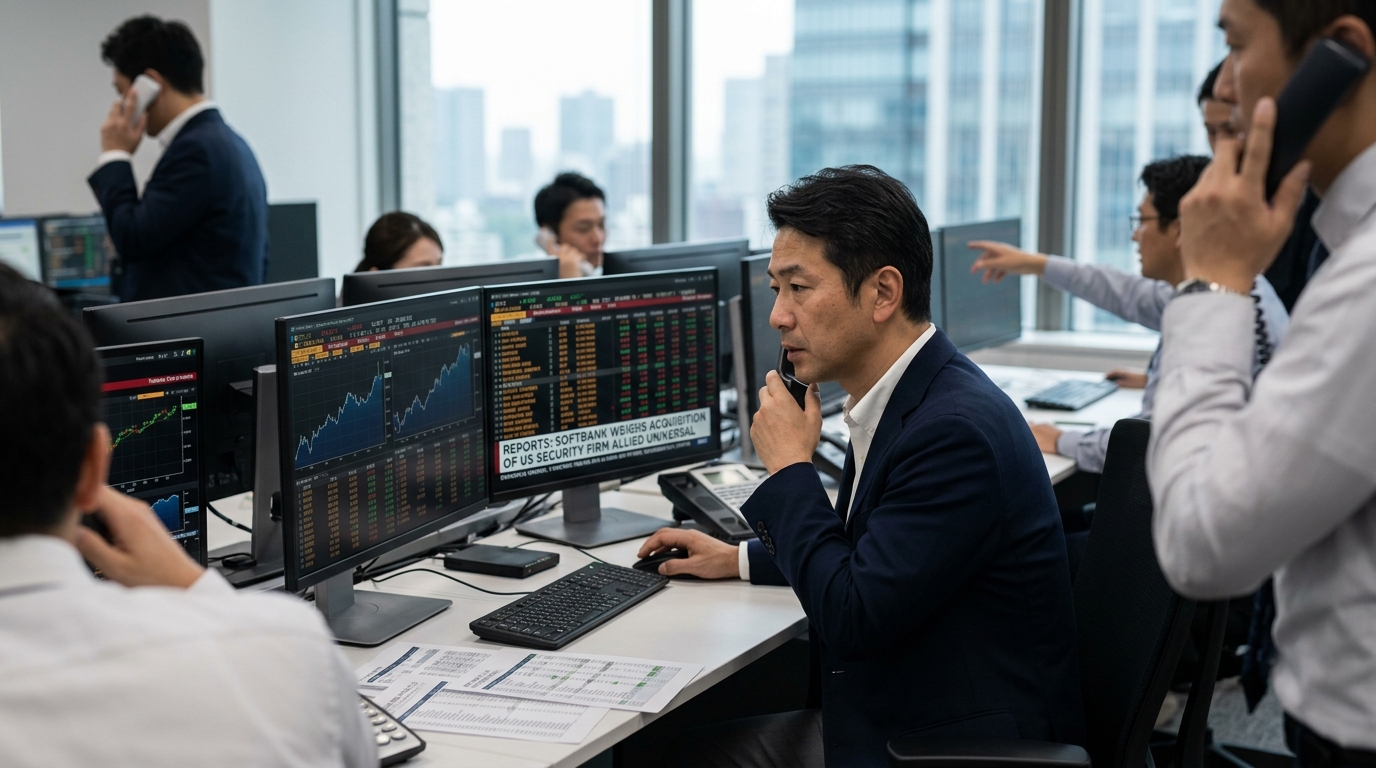
Masayoshi Son does not need to close a deal to move markets. He just needs to be reported as considering one.
Bloomberg broke the story Friday evening, with Reuters confirming through its own sources: SoftBank Group is considering an acquisition of Allied Universal in a deal that could value the US security services provider at about $18 billion. By the time most traders logged on Monday morning, the strategic logic had already been dissected across every major financial outlet. The discussions remain in the early stages, and there is no guarantee a transaction will materialise. That caveat rarely slows sentiment.
9984 closed Monday at ¥4,700, down 4.94% on the session, which tells you something worth sitting with. The news was out Friday, the stock rallied that day, and by Monday the enthusiasm had reversed. That sequence is familiar to anyone who has traded SoftBank through a deal cycle. The initial read is bullish, Son is spending again, AI ambitions confirmed, and then the market remembers the bill.
Why Allied Universal Makes Sense to Son
Son is exploring ways to deploy AI-powered robots across industries, and Allied Universal hands him the single largest deployment opportunity available. Allied Universal, one of the largest private security providers in the United States, supplies personnel to commercial properties, businesses, entertainment venues and major public events. That is an enormous installed base of repetitive, location-fixed tasks, precisely the environment where humanoid robots are closest to viable.
There is a second angle traders should not overlook. The company has also been expanding its activities in the data center industry, providing services for facilities involved in the development and operation of digital infrastructure. SoftBank already owns Arm and holds roughly 13% of OpenAI. A security firm with a growing data center footprint fits that portfolio more neatly than the headlines suggest.
Data center security is only one layer of the infrastructure constraint. The deeper bottleneck facing every data center operator is electricity supply, where capacity shortfalls are already driving up costs.
With Allied, SoftBank would look to eventually replace some staff with robots for certain security tasks, though the deployment of humanoid security workers is likely to take longer. That qualifier matters. The robot thesis is real but slow. Traders pricing in near-term automation revenue from this deal are running well ahead of the actual timeline.
The Capital Structure Deserves Attention
The $18 billion figure refers to equity only. Allied Universal also has about $12 billion of publicly traded debt, across loans and bonds. That makes the total enterprise value closer to $30 billion, a materially different number when assessing what SoftBank is actually taking on. Warburg Pincus and Canadian pension fund La Caisse currently back the security company and will be looking for a clean exit at a premium. Financing structure remains unresolved.
SoftBank has increasingly concentrated its investment strategy on AI infrastructure, including a $64.6 billion commitment to OpenAI, data center development and semiconductor designer Arm Holdings. Adding a $30 billion gross obligation on top of that stack is not trivial, even for Son.
The Trader’s Lesson
Son’s dealmaking is its own market catalyst. The announcement of intent, the sourced rumor, the Bloomberg headline, each one moves related names before any contract is signed. Disciplined traders watch that pattern and resist chasing the first-hour gap. The real opportunity, if one develops, tends to emerge after the initial surge fades and the market starts asking harder questions about price, debt, and timeline. That is when you have real information rather than just momentum. Wait for the second chapter before committing capital to the first one.