
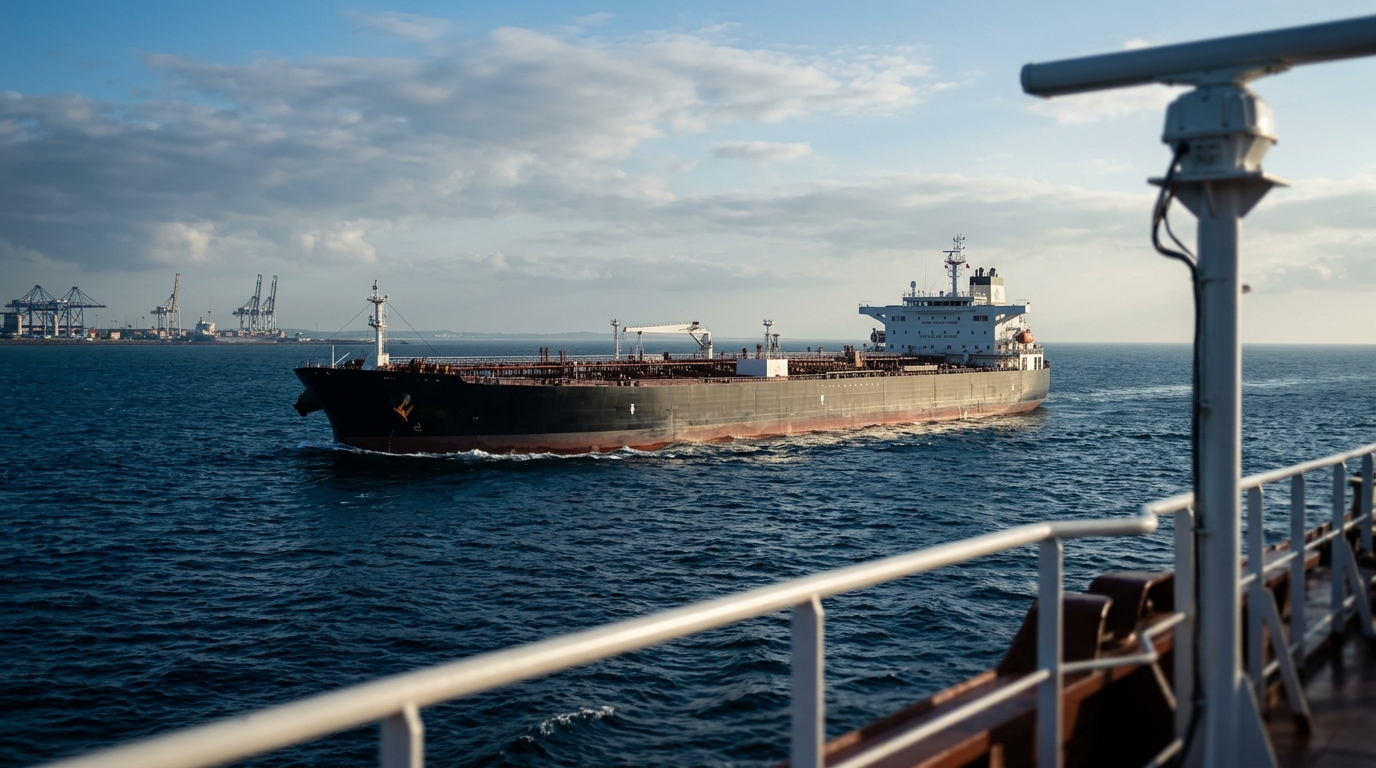
Watch Brent carefully enough and you might miss what is actually moving tanker stocks. Global crude oil shipping costs are now about seven times higher than a year ago, with the global average crude freight rate surging above $20 per barrel from about $3 per barrel a year ago. Goldman Sachs published a breakdown this week that is more useful than the headline number.
The bank identified five key factors behind the roughly $20 per barrel year-on-year increase. The single largest is a $7 per barrel war-risk premium for crossing the Strait of Hormuz, followed by $4 from ship-to-ship transfers outside the Persian Gulf, $4 from higher maritime fuel prices, $3 from inefficient tanker allocation and vessel diversions, and $2 from restrictions on the Iranian fleet. That Hormuz premium alone accounts for roughly a third of the entire freight increase. It is not a crude-supply story. It is a toll.
Baltic Exchange data shows the Ras Tanura-to-Ningbo VLCC rate topped $1 million a day for the first time in mid-September, later reported near $1.1 million a day. Meanwhile, Brent has been trading well above $100 a barrel in October. Those two numbers are running in opposite directions in trader attention. Crude is getting the headlines. The freight rate is getting the earnings.
In the second quarter of 2026, Frontline (FRO) reported net income of $659.2 million. DHT has also posted record profitability this year, and said first-half profit had already beaten the best full year in its history. Teekay Tankers (TNK) reported total liquidity of about $1.3 billion as of June 30, 2026, including cash and short-term investments. These are not fringe shipping plays anymore. They are cash machines priced on day rates, not on the barrel.
The split between spot and term exposure is where the differentiation lives. Frontline is heavily spot-exposed, which is why it moves the most when rates move. DHT has meaningful time-charter coverage alongside spot exposure, which cushions it in both directions. International Seaways (INSW) sits between those two in its contract mix, giving it different rate sensitivity than either.
There is a risk the desk is watching. Reuters reported on October 15, 2026 that the Trump administration is considering easing sanctions on selected shadow-fleet vessels, a move that could expand the pool of ships competing for mainstream cargoes, though analysts question whether it would unlock enough usable vessels to meaningfully lower tanker rates. DHT, Frontline, and International Seaways sold off in the days around that report. The market priced the risk fast. Whether it priced it correctly is the question traders should be sitting with.
The same Hormuz disruption that inflated tanker day rates has also broken the product market in ways crude prices alone do not capture. Refiners like Marathon Petroleum and Valero have been extracting record crack spreads from the same supply dislocation that is filling tanker balance sheets.
Goldman Sachs said these factors “will likely continue to support global freight rates as long as the conflict in the Middle East persists.” Breakwave Advisors noted the VLCC market is softening from its peak, but contends the downside is limited, as exceptionally high freight costs have softened long-haul Atlantic-to-Asia demand.
The trader’s lesson here is about where the real price discovery is happening. Crude looks range-bound if you are only watching the screen in crude futures. The Ras Tanura-to-Ningbo freight rate is where the war is actually being priced. Stocks like FRO, DHT, INSW, and TNK are not oil proxies right now. They are war-premium proxies, which means the catalyst to watch is any credible signal of Hormuz normalization, not the next OPEC meeting.