
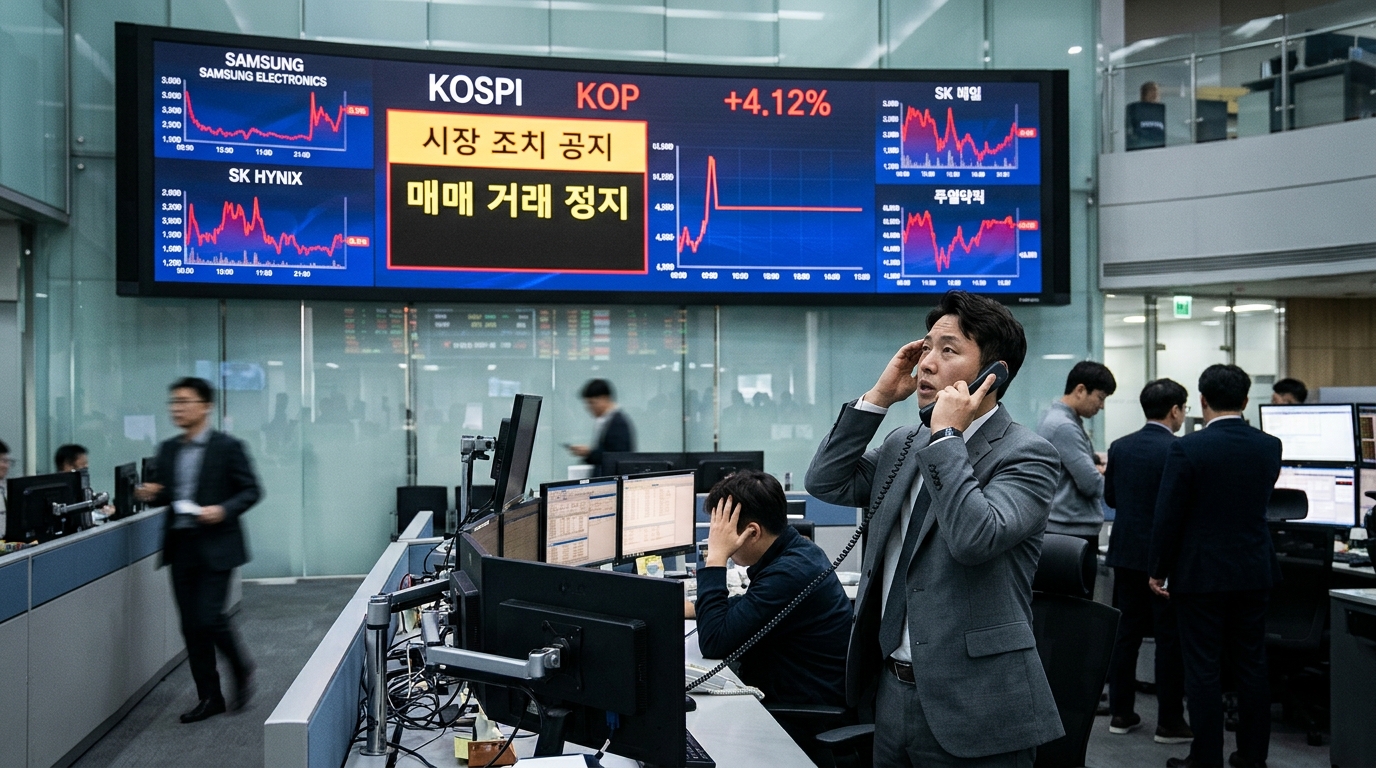
The Korea Exchange paused program buying for five minutes this morning, the second such halt in six days, after the KOSPI surged more than 4% on news that Anthropic has begun the process of pursuing an IPO. Six days ago, the same mechanism fired on the downside. A market that needs its own brakes twice in a week, in opposite directions, is not in the middle of a rally. It is in the middle of a voltage spike.
The fundamental backdrop is real and it deserves its own moment. The Bank of Korea reported this morning that Q3 real GDP grew 1.0% quarter-on-quarter and 3.4% year-on-year, against the BoK’s own August forecast of just 0.3%. Korea’s economy expanded 1 percent from the previous quarter in the July-September period, exceeding the central bank’s 0.3 percent projection, driven by semiconductor- and machinery-led exports. Real gross domestic income rose 18.8 percent on-year in the third quarter, the biggest year-on-year gain since the fourth quarter of 1977. That is not a rounding error. That is a country whose terms of trade have shifted structurally in favor of chip exporters.
A Bank of Korea official estimated that semiconductors account for about half of overall economic growth. Exports rose 2.3 percent, led by semiconductors, machinery and electrical equipment, while imports increased 2.4 percent, led by crude oil and semiconductor manufacturing equipment. Facility investment climbed 4.1%, concentrated largely in machinery, including semiconductor manufacturing equipment. This is an economy running on one engine at full throttle.
Which is precisely the problem the market is not pricing this morning.
Despite the sharp rise in real income, household spending remained weak. Private consumption contracted 0.2% quarter-on-quarter, recording its first decline since the fourth quarter of 2022. Spending fell across goods, including passenger vehicles and home appliances, as well as services such as financial services and dining. The BoK attributed the decline partly to reduced spending on financial services amid a stock market correction and sluggish automobile sales caused by strikes at passenger car manufacturers. Strip those two temporary drags out and the BoK estimates consumption would have risen 0.4%, but the structural pressures, high household debt and an aging population, are not temporary.
Back to this morning’s halt. The KOSPI surged more than 4% during the session, triggering a temporary suspension of program buy orders. Program buy orders in the securities market were suspended for five minutes at around 10:13:53 a.m. due to a change in the KOSPI 200 Futures Index. The strength in domestic equities was attributed to growing investor expectations for semiconductor stocks after news that Anthropic is pursuing an initial public offering.
Foreign and institutional investors drove the index higher with net purchases of 428 billion won and 271.1 billion won, respectively. Retail investors sold a net 724.3 billion won. Retail selling into a foreign-driven rally, with program orders the marginal price-setter, is exactly the condition that produces oversized swings and automated brakes. Sidecars are far more commonly associated with sharp sell-offs, so an upside trigger points to the mechanical amplification of a buying burst, typically short covering, index futures flow, or clustered program orders.
The six-day sequence also matters. The prior sidecar was a sell-side trigger on October 13, 2026, and chip earnings land this week.
SK Hynix is scheduled to report Q3 earnings on October 28, 2026 (Seoul time). That result will set the tone for everything the KOSPI is currently pricing in about AI chip demand. With the economy posting a third consecutive quarter of surprise growth, attention is turning to the Bank of Korea’s rate decision in November. Some banks, including Morgan Stanley, have forecast a November rate hike. Tighter policy into slowing consumption is not the setup the bulls need.
The GDP number is genuinely strong. But a market that swings 4% or more twice in a week, halting its own program orders both times, is telling you it is running on thin positioning and large bets rather than broad conviction. EWY, which tracks the KOSPI for international investors, is worth watching closely against SK Hynix’s earnings on Wednesday. If the results disappoint after a roughly 4% intraday surge today, the next sidecar could come faster than the last one did.