
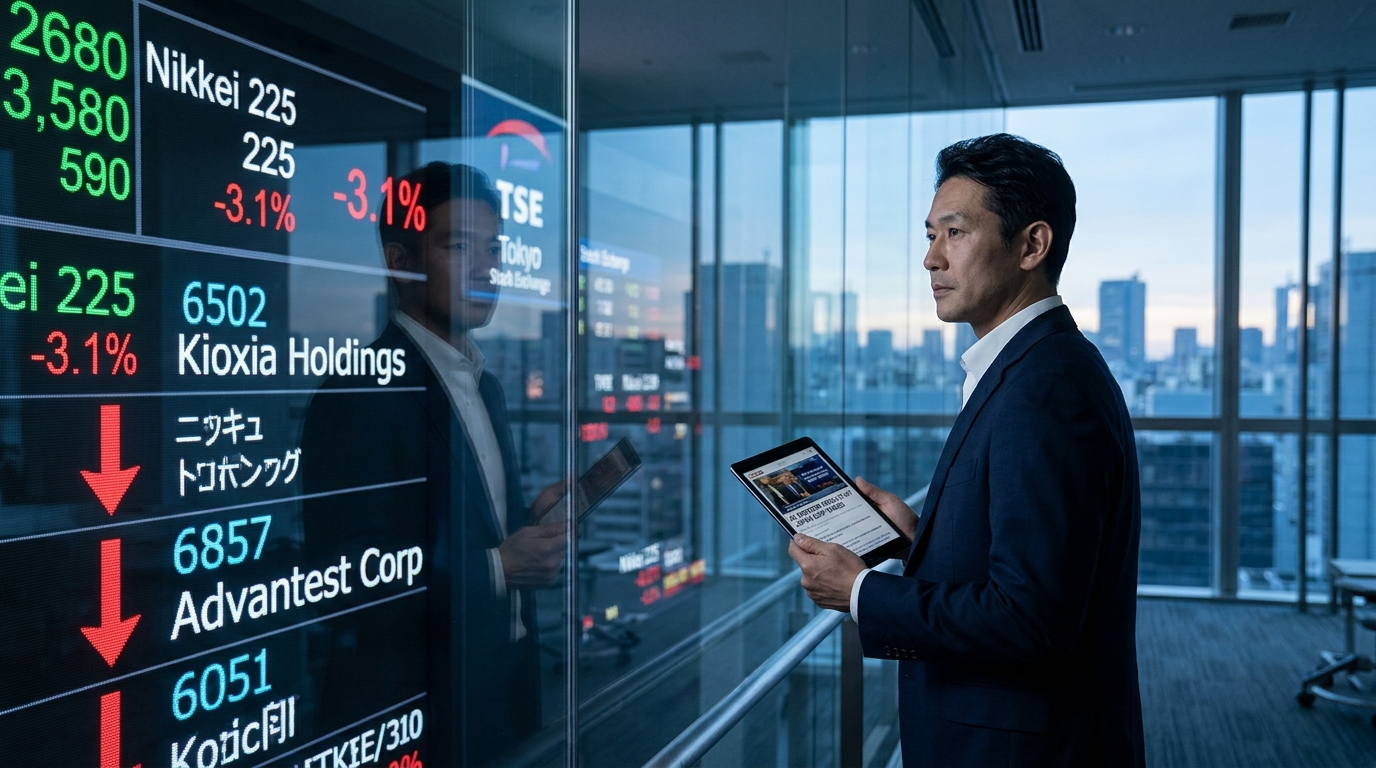
When the US midterm results started flowing into Asian trading hours on Wednesday, the sell order didn’t land on Nvidia or Broadcom. It landed on Kioxia, Advantest, and SoftBank. That asymmetry is worth understanding, because it will happen again.
Asian stocks slid as Democrats led the US midterm count, hitting AI shares. The session before, in New York, the story had been entirely different. The tech/AI trade staged a partial recovery Tuesday and broke a three-day losing streak, with the Philadelphia Semiconductor Index gaining about 2.6%.
US chip stocks rallied into election night. Their Japanese counterparts paid the tab the next morning.
What Happened
Japan’s Nikkei share average fell more than 3% on Wednesday as AI-related stocks slumped on US midterm-election headlines. The individual moves were sharp. Chip-related shares took the brunt of the selling: Advantest fell 6.4% and Tokyo Electron dropped 5%, while technology investor SoftBank Group lost about 7%. Memory chip maker Kioxia slumped 10%. Optical cable makers followed. Fujikura and Furukawa Electric dropped 8.2% and 9%, respectively.
Of the 225 stocks in the Nikkei, 130 fell and 95 rose, suggesting investors were targeting AI-exposed names rather than selling Japanese equities across the board. This was not a broad Japan macro trade. It was a surgical unwind of the data-centre supply chain, applied to the market that happened to be open first.
Why It Happened
Japan’s Nikkei average slumped as AI-related stocks slid on concerns that Democratic gains in the US midterm elections could lead to stricter rules for data-centre projects and slower AI infrastructure spending. The fear, stated plainly by one portfolio manager: “Democrats are winning seats in some key states. That fuelled caution for stricter regulations on AI infrastructure investment,” said Takamasa Ikeda, senior portfolio manager at GCI Asset Management.
The companies hit hardest sit at the earliest points of the data-centre supply chain. Kioxia supplies NAND flash memory. Advantest tests the chips that go into AI servers. Tokyo Electron makes the deposition and etch equipment those chips require. None of them are deciding how much the US government spends on AI infrastructure. All of them feel it first when that spending is questioned.
It also follows strong results from US chip and server makers overnight, a reminder that political risk is now competing with earnings as a driver of AI stocks. AMD reported third-quarter revenue growth of 45% and raised its fourth-quarter outlook after Tuesday’s US close. The Nikkei sold off anyway. Earnings and election risk were pointing in opposite directions, and Asia had to resolve the tension before New York reopened.
How Professionals Might View It
Experienced traders recognise Japan and Korea as the overnight shock absorbers for US political risk in the AI trade. For Korea, the combination of crowded AI positioning, a rapid recent rally and the heavy weighting of Samsung and SK Hynix in the KOSPI means a reversal in the semiconductor trade can have an outsized impact on the entire market. The same logic applies to Tokyo, where chip-equipment and memory names carry enormous index weight.
This dynamic has played out before. Japanese and South Korean chip stocks have absorbed coordinated unwinds that US holders of the same names should track closely.
Selling also reflected unease over elevated valuations following the substantial gains recorded by technology shares earlier in the year. The divergence between robust corporate earnings and falling share prices highlighted the increasingly cautious sentiment among traders, particularly toward companies exposed to the global technology investment cycle. In other words, the election gave traders a reason to act on a valuation concern they were already carrying.
What Comes Next
Watch how US semis open Thursday. If the Philadelphia Semiconductor Index holds the ground it reclaimed Tuesday, the Nikkei names that sold off hardest, Kioxia and Advantest especially, become candidates for a catch-up recovery, not because the regulatory risk has disappeared, but because the acute positioning flush will have run its course.
Jung Jung-Young, a researcher at Korea Investment and Securities, noted that the market views the midterms as an event that removes uncertainty, and that tech stocks could see short covering once the results are confirmed. That dynamic applies in Tokyo as much as Seoul. Clarity, even unwelcome clarity, tends to be less punishing than uncertainty.
Regulatory risk is not the only pressure competing with earnings. Credit markets have been pricing a materially wider spread on AI-related debt than equity investors have accepted.
The Trader’s Lesson
Asia does not just follow Wall Street. In AI-linked names, it functions as the first venue for US political risk, absorbing moves that US markets have not yet had the chance to price. When a major US event breaks overnight, the size of the move in Tokyo or Seoul is not just a data point about those markets. It is the market’s first read on how serious the shift is considered to be. Traders who understand which geography absorbs which risk, and why, will be better positioned to interpret those early signals rather than simply react to them.